
Saturn’s cloud-shrouded moon Titan is struggling to keep its secrets. French astronomers who have peered through the mist using ground telescopes say they have spotted polar caps and lofty mountains covered with methane ice. But an American researcher says that images from the Hubble telescope paint a different picture.
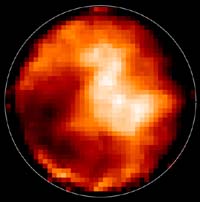
Athena Coustenis of the Paris-Meudon Observatory and her colleagues used a telescope adapted to pick up infrared light from Titan. They discovered a wide, bright region stretching one-sixth of the way around the moon’s equator, with two or three even brighter spots dotted along it.
“I think it could be a mountain, a plateau with peaks,” says Coustenis. She believes the brightness is caused by methane ice caps.
Coustenis has also spotted bright regions close to Titan’s poles, which she suspects are polar caps, again of methane ice. The northern one is twice as bright as its southern sibling.
The differentiated surface rules out a hydrocarbon ocean, which was once thought to cover Titan, she says.
Instead, her team’s observations suggest a surface mostly covered by water ice and hydrocarbon lakes, Coustenis told the European Geophysical Society meeting in Nice, France, last month.
Ralph Lorenz, a planetary scientist at the University of Arizona, agrees that Titan’s large bright area could be mountainous. “I’m actually a big fan of mountains on Titan,” he says.
However, he doesn’t think they could be tall enough for a topping of methane ice. Methane rainfall could brighten them by washing away a dark coating of hydrocarbons, he says.
Lorenz is more sceptical about the possibility of polar caps on Titan. He thinks that images from the Hubble Space Telescope suggest that Coustenis may just be picking up regions of cloud.
“I’d say that basically the data is not yet good enough to be making strong conclusions,” he says.
This article appeared in the May 13 issue of New Scientist New Scientist. Copyright 2000 – All rights reserved. The material on this page is provided by New Scientist and may not be published, broadcast, rewritten or redistributed without written authorization from New Scientist.
