

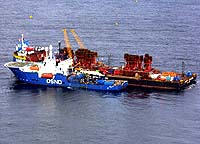
The long-delayed operation to raise the sunken Kursk submarine from the bottom of the Barents Sea was accomplished successfully Monday to the almost palpable relief of the Russian navy.
The lifting of the Kursk began at 3:45 am (2345 GMT Sunday) after salvage experts succeeded in wresting the 20,000-tonne vessel from the bed of silt 112 metres (370 feet) under water, a spokesman for the Dutch contractors Mammoet-Smit, Lars Walder, told AFP.
Fifteen hours later, it was all over — or, at any rate, the second phase of the complex salvage operation began, with the Giant-4 barge operated by Mammoet-Smit towing the crippled sub towards dry dock on the Kola peninsula.
“It was necessary to use a force of 9,000 tonnes to raise the wreck from the deep,” Walder told reporters.
The vessel sank on August 12, 2000, with the loss of all 118 crew aboard, while on-off preparations to raise the hull have taken almost three months due to bad weather in the Arctic circle.
Twenty-six steel cables, each weighing 22 tonnes, lowered from the Giant-4 barge raised the nuclear sub to the point where it could be towed to shore, said Vice Admiral Mikhail Motsak, head of Russia’s Northern Fleet.
The towing operation began shortly after 6:30 pm (1430 GMT) Monday.
But Motsak was already in celebratory mood at the success of the lifting phase, telling journalists: “The emotion was very great when we heard this news, because it means this enormous labour by divers, sailors and technical experts has not been in vain.”
“The Kursk is no more lying on the bottom of the sea,” added an equally upbeat Walder.
“Everything is going according to plan. The freeing of the Kursk from the seabed was even easier than we had thought it would be,” said Vladimir Navrotsky, a Northern Fleet spokesman.
“The only thing we could fear is the bad weather. According to the weather forecast, we should expect a downturn on Tuesday,” Navrotsky added.
The Kursk, Russia’s most modern nuclear-powered submarine, sank after a series of explosions on board which have still not been explained.
President Vladimir Putin ordered the vessel to be raised after promising the seamen’s families that their relatives’ bodies would be recovered.
It is hoped that the 65-million-dollar (71-million-euro) salvage operation will cast some light on the accident that sent the Kursk to the bottom of the sea.
Although the Russian navy says risks are negligible, the presence of 18 torpedoes, 22 Granit missiles and two nuclear reactors inside the sunken vessel has given environmentalist groups and experts serious reasons to worry.
There had been conflicting reports as to whether salvage operators had managed to cut away the bow of the sub, which stored most of the weapons on board.
Salvage workers raced against time as the Arctic winter closed in and threatened to scupper the whole operation until next year.
The Kursk’s bow — the most damaged part of the submarine, which holds its torpedoes — is to remain under the sea at least until next year.
The raising of the Kursk was originally scheduled for September 15 but the operation was repeatedly delayed, owing to technical problems and bad weather.
All rights reserved. ¿ 2000 Agence France-Presse. Sections of the information displayed on this page (dispatches, photographs, logos) are protected by intellectual property rights owned by Agence France-Presse. As a consequence, you may not copy, reproduce, modify, transmit, publish, display or in any way commercially exploit any of the content of this section without the prior written consent of Agence France-Presse.
