

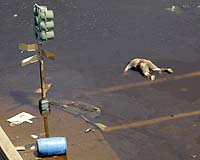
US meteorologists use the five-category Saffir-Simpson Hurricane Scale to rank hurricane intensity, providing useful data for emergency planning.
This year’s North Atlantic hurricane season, from June 1 through November 30, will be “very active”, with conditions favoring more and stronger storms, the National Oceanic and Atmospheric Administration’s National Hurricane Center predicts.
The Saffir-Simpson category rating is based on the hurricane’s present intensity, which is used to give an estimate of the potential property damage and flooding expected along the coast from a hurricane landfall.
Wind speed is the driving factor in the scale, as storm surge values are highly dependent on the slope of the continental shelf and the shape of the coastline in the landfall region.
Here are summaries of the categories used by the National Hurricane Center:
– Category one: Winds 74-95 miles (119-153 kilometers) per hour.
No real damage to building structures. Damage primarily to unanchored mobile homes, shrubbery, and trees.
– Category two: Winds 96-110 miles (154-177 kilometers) per hour.
Some roofing material, door, and window damage of buildings. Considerable damage to shrubbery and trees with some trees blown down. Considerable damage to mobile homes, poorly constructed signs, and piers.
– Category three: Winds 111-130 miles (178-209 kilometers) per hour.
Some structural damage to small residences and utility buildings; damage to shrubbery and trees with foliage blown off trees and large trees blown down. Mobile homes are destroyed. Flooding near the coast destroys smaller structures with larger structures damaged by battering from floating debris.
– Category four: Winds 131-155 miles (210-249 kilometer) per hour.
Some complete roof structure failures on small residences. Shrubs, trees, and all signs are blown down. Complete destruction of mobile homes. Major damage to lower floors of structures near the shore. Terrain lower than 10 feet (three meters) above sea level may be flooded, requiring massive evacuation of residential areas as far inland as six miles (10 kilometers).
– Category five: Winds greater than 155 miles (249 kilometers) per hour.
Complete roof failure on many residences and industrial buildings. Some complete building failures; all shrubs, trees, and signs blown down. Complete destruction of mobile homes. Severe and extensive window and door damage. Major damage to lower floors of all structures located less than 15 feet (4.6 meters) above sea level and within 500 yards (meters) of the shoreline. Massive evacuation of residential areas on low ground within five to 10 miles (eight to 16 kilometers) of the shoreline may be required.
Only three category five hurricanes have made landfall in the United States since records began: The Labor Day Hurricane of 1935, Hurricane Camille (1969), and Hurricane Andrew in 1992.
