
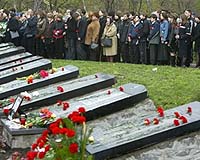
Russian scientists on Tuesday downplayed the impact of the 1986 Chernobyl nuclear disaster, saying victims suffered more emotional and sociological trauma than actual illness caused by radiation.
“Most of those who took part in rescue operations at the plant after the accident believe that the impact of radiation on people’s health is open to debate,” the director of the Institute of Nuclear Problems, Igor Lingue, said.
He was speaking at a news conference marking the 20th anniversary of the worst nuclear accident in history.
“Compared to the radiation caused by Chernobyl, the other factors triggered by the accident such as psychological stress, the disruption of their lives and financial losses proved to be greater problems for the population,” he added.
Lingue said of the 600,000 so-called liquidators — soldiers, firemen and civilians who were deployed over the next four years to clean up after the disaster — “only 5,000 have died in the past 20 years”.
This meant that their mortality rate was no higher than that of Russia’s male population, he added.
Lingue said major social problems ensued however because of the emergency evacuation of some 300,000 people after the fourth reactor at Chernobyl blew up.
“We put them up in deserted towns, in makeshift housing. Sometimes they were not accepted by the local populations.”
A World Health Organisation report released in September estimated the overall death toll from the catastrophe in what is now a part of Ukraine on April 26, 1986, at 4,000.
The figure has been contested by anti-nuclear lobbies.
Greenpeace said on Tuesday that the radiation caused by the explosion was likely to eventually cause an additional 93,000 cancer deaths in Russia, Ukraine and Belarus.
But the French Nuclear Energy Society (SFEN) has come out in support of the UN report, calling it “the most thorough ever assembled on the consequences of the accident”.
Source: Agence France-Presse
