

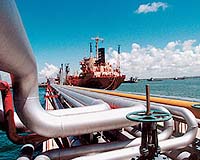
Russia will start work in December to build the first section of an oil pipeline to run from eastern Siberia to the Pacific coast amid rising Asian demand, a Russian executive involved in the project said Friday.
The section between Taishet, close to Siberia’s Lake Baikal, and Skovorodino, close to the frontier with China, will follow the Baikal-Amur railway, Mikhail Chemakin, head of a subsidiary of Russian pipeline monopoly Transneft, said.
The route would allow the materials needed to build the pipeline to be carried by rail, Chemakin said.
Officials in charge of the project “have heeded the voice of civil society and the ecologists and have corrected the route of the pipeline six times,” he said.
The pipeline plan has prompted fierce competition between China and Japan as they are both concerned about future energy supplies.
At the end of 2004, Moscow said that the pipeline would be built from Taishet to Perevoznaya bay on Russia’s Pacific coast at a cost of 15 billion dollars (12.4 billion euros) and that a spur would later be built to China.
But Moscow has so far only committed to building the section to Skovorodino — several hundred kilometres (miles) short of the coast, raising Japanese concerns that China could be the main beneficiary.
President Vladimir Putin on Wednesday criticised the negative attitude taken by some environmentalists to the project.
“As soon as we start to do something, one line of attack against us is always environmental problems… Ecological expertise shouldn’t obstruct the development of the country or the economy,” Putin said.
Having to build the pipeline around the northern shore of Russia’s Lake Baikal had cost “hundreds of millions of dollars more,” Putin said.
