
Robots will be laying explosives, going underground after blasting to stabilize a mine roof or mining in areas where it is impossible for humans to work or even survive say CSIRO scientists.
Robotic mining machines and other Australian technologies like the 3D Virtual Mine are poised to boost the safety and productivity of mines around the world.
CSIRO and other Australian scientists will tell an international conference on mine safety in Perth this week how a suite of novel Australian technologies, including nano-technology, can help slash the risk to miners.
“A superior safety management system effectively communicating data such as seismic events, geochemistry and mine stability to the wide variety of people involved in a mine’s operation is now within our grasp,” says CSIRO’s Mining Science Coordinator, Dr Cliff Mallett.
“These technologies will help cut the death and injury toll that in the decade to 1998 saw 256 Australian miners die and over 64,000 injured.”
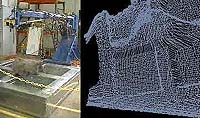
CSIRO have now developed the 3D Virtual Mine that combines data from many sources into a visually integrated 3D model of the entire minesite, which has many advantages over the normal ‘flat table’ documents and datasets currently in use. Importantly, the model can be run using common web-browser software.
“A picture can speak 1000 words,” says Dr Mallett. “A visual representation of data such as gas concentration can give a more intuitive picture of site conditions than a panel full of dials and a screen full of numbers.
“In the event of an accident, a full 3D visualization of the site and infrastructure can help emergency staff, who may be unfamiliar with site conditions, quickly assess the situation and plan a rescue.
Safety is also one of the key factors driving the trend to automation.
“CSIRO has an opportunity and challenge to improve real safety in mining through design of automated systems,” says Mr Jock Cunningham, CSIRO Principal Research Scientist.
CSIRO are trialling and developing a range of giant robotic mining devices, that will either operate themselves under human supervision or else be ‘driven’ directly by a miner, in both cases from a safe, remote location.
“It is all about getting people out of hazardous environments,” says Mr Cunningham.
Examples of the trend to mining automation include:
- tele-operated and automated load-haul-dump trucks that self-navigate through tunnels, clearing the walls by centimetres
- the world’s largest ‘robot’, a 3500 tonne coal dragline featuring automated loading and unloading
- a robot device for drilling and bolting mine roofs to stabilize them after blasting
- a pilotless burrowing machine for mining in flooded gravels and sands underground, where human operators cannot go
- a robotic drilling and blasting device for inducing controlled caving.
CSIRO Research Engineer Graham Winstanley says, “The automation of the dragline swing will greatly improve productivity maintenance. Technologies like these will also lead to fundamental changes in mining methods.”
“Limitations on the dimensions of mine openings, ventilation and equipment design will disappear allowing for more innovative mining methods. For example, nano-technology and ‘far-out’ technologies that we, as yet, can’t even imagine.
“The issues highlighted in these papers can and will be solved,” he says.
