
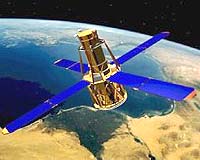
On-orbit checkout of Spectrum Astro’s spacecraft
subsystems confirms that they are performing flawlessly for the RHESSI satellite. Since its launch on February 5, 2002, the Reuven Ramaty High Energy Solar Spectroscopic Imager, or RHESSI, satellite has been transmitting solar observation data for Principle Investigator Dr. Bob Lin and NASA Goddard Space Flight Center (GSFC).
Spectrum Astro manufactured the spacecraft bus and provided integration support to the mission’s Prime Contractor, the University of California, Berkeley (UCB).
Each of the seven major subsystems within the Spectrum Astro-built spacecraft bus was verified to be operating nominally. These include the Structure and Mechanisms, Solar Arrays, Attitude Control, Thermal Control, Command and Data Handling, Electrical Power, and Telecommunications.
“We’re pleased to see that RHESSI is successfully doing its mission for Dr. Lin, UCB and Goddard Space Flight Center,” said W. David Thompson, Spectrum Astro President & CEO. “It’s a great example of a low cost, high performance satellite.”
During its planned two-year mission, RHESSI will study the secrets of how solar flares are produced in the Sun’s atmosphere. Launched February 5, RHESSI was fully operational after only 2 weeks in orbit. It is observing the Sun and recording the high-energy radiation from solar flares as they occur. RHESSI is a sun-pointed, inertial spinner spacecraft that is orbiting at an altitude of 600 km, inclined at 38 degrees. Incorporating Spectrum Astro’s proven, flexible VME based electronics architecture, each of the vehicle’s seven major subsystems is designed to minimize programmatic and technical risk while delivering superior performance.
The RHESSI scientific payload is a collaborative effort among the University of California, Berkeley; Goddard; the Paul Scherrer institute in Switzerland; and the Lawrence Berkeley National Laboratory in Berkeley. The mission also involves additional scientific participation from France, Japan, The Netherlands, Scotland, and Switzerland. The Explorers Program Office at Goddard manages the RHESSI mission for NASA’s Office of Space Science in Washington.
