
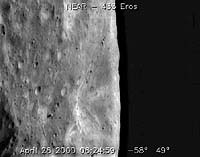
Eros, the chunky asteroid named after the god of love, is slowly revealing to scientists the mysteries of its size, rotation and other properties.
Eros has been studied by the Near Earth Asteroid Rendezvous (NEAR)-Shoemaker spacecraft since last Valentine’s day when a careful maneuver put the spacecraft in orbit around the asteroid to determine its properties. Some of those findings, such as Eros’ mass and bulk density, appear in the September 22, 2000 edition of the journal Science in a paper by principal author Dr. Don Yeomans of NASA’s Jet Propulsion Laboratory. Yeomans is the radio science team chief for NEAR-Shoemaker. The journal also features three other research reports on Eros.
Scientists have learned that Eros is most likely made of rocky material with a uniform density throughout. The asteroid’s bulk density is similar to that of Earth’s crust. Like Earth, the surface of Eros is covered with a layer of looser rock and soil.
Though it is about 6,700 trillion kilograms (14,700 trillion pounds) in mass, Eros is a fragment from the breakup of a once larger asteroid. “It’s a chip off a larger block from millions of years ago,” said Yeomans.
Eros is rotating around its shortest axis, making one revolution every 5 hours and 16 minutes. As though thrown in a tight spiral pass by some cosmic quarterback, Eros’ rotation axis appears to remain steady on its journey through space. Because the asteroid is so much smaller with much less gravity than Earth, it wouldn’t take an Olympic athlete to jump entirely off the surface into space.
Scientists were able to study Eros’ rotation, mass distribution and structure based on a series of observations taken onboard the spacecraft. By photographing the asteroid and measuring infrared light reflected from it, scientists could determine its mass, detect minerals and record its motion. As the craft edged into closer and closer orbits around the asteroid, it took fresh data that helped determine the asteroid’s size, shape and mass distribution. These activities were critical for navigating the spacecraft in to tighter orbits about Eros so that close-up images could be taken.
“If we didn’t know the precise size, shape and mass distribution of the asteroid ahead of time, it would not have been safe to send the spacecraft to within a few kilometers of the asteroid’s surface,” said Yeomans.
By the mission’s end in February 2001, the total surface of the asteroid will have been imaged and measured.
Johns Hopkins University manages the NEAR mission for NASA, and JPL is performing navigation support. Bobby G. Williams, also an author on the paper, is the navigation team leader.
