
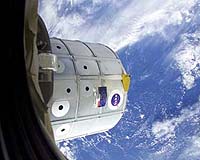
The module that will deliver food, clothing, spare parts and research equipment to the International Space Station is being prepared for the Space Shuttle Return to Flight mission.
The Italian-built Multi-Purpose Logistics Module, Raffaello, is filled with cargo at NASA’s Kennedy Space Center, Fla. It will fly on the Shuttle Discovery (STS-114) mission targeted for launch in May.
Raffaello will carry 12 large containers, (racks) to the International Space Station. Included in the cargo is the Human Research Facility (HRF-2), which will expand the ISS capability to support human life sciences research.
A similar facility, HRF-1, has conducted research since it was installed into the Destiny module in May 2001. The research includes using an ultrasound unit measuring bone loss and a gas analyzer system.
“This is a significant milestone for the Station,” said Bill Gerstenmaier, ISS Program Manager.
“With Raffaello’s supply transport capabilities, we will be in a better posture onboard Station after this first Shuttle mission. Raffaello will also deliver a unique biomedical research capability with the HRF-2. It will help us learn more about humans living in space.”
Returning the Shuttle to flight and completing the ISS are the first steps in the Vision for Space Exploration, a stepping-stone strategy toward new exploration goals. Using the ISS to study human endurance, adaptation in space, to test new technologies and techniques, NASA will prepare for the longer journeys to the moon, Mars and beyond.
Biomedical instrumentation aboard HRF-2 includes a pulmonary function system for use in conjunction with exercise equipment to obtain measurements of aerobic capacity and cardiac output; a refrigerated centrifuge used to separate biological substances of differing densities; a space linear acceleration mass measurement device to determine the on-orbit mass of crewmembers; and an upgraded workstation used for data handling and storage.
Scientific data generated by the HRF will provide insight into how crewmembers adapt to long-duration spaceflight and will assist in developing procedures to ensure crew health for longer journeys through the solar system.
The first of the supply racks was installed in Raffaello at KSC on March 4 and the HRF-2 rack was installed on March 8. Rack installation will be completed within the next week.
KSC and NASA’s prime contractor for ISS element processing, The Boeing Company, prepared the racks for installation.
The HRF Project is managed by NASA’s Johnson Space Center and implemented by Lockheed Martin in Houston. Raffaello was built by the Italian Space Agency for NASA under a cooperative space agreement.
Redesigned External Fuel Tank Arrives At Kennedy Space Center
Washington (SPX) Mar 16, 2005
The second redesigned Space Shuttle External Tank (ET) is in place at NASA’s Kennedy Space Center (KSC), Fla. It is designated for use on the Shuttle Atlantis Return to Flight mission (STS-121) .
The ET incorporates several safety improvements, including an improved bipod fitting that connects the tank to the orbiter. In addition, the tank has temperature sensors and accelerometers, used to measure vibration and to collect data about its performance.
In the huge KSC Vehicle Assembly Building, the ET will be raised from a horizontal to a vertical position this week and lifted high into a checkout cell.
It will undergo mechanical, electrical and thermal protection systems’ inspections. New processing activities, resulting from redesign of the tank, include inspection of the bipod heater and ET separation camera.
When tank preparations are complete, it will be attached to Atlantis’ Solid Rocket Boosters, on the Mobile Launch Platform. STS-121 is NASA’s second Return to Flight mission, a test flight carrying a seven-member crew to the International Space Station. The launch planning window is July 12 through July 31.
The ET traveled more than 900 miles by sea from NASA’s Michoud Assembly Facility, New Orleans on board the Solid Rocket Booster Retrieval Ship Freedom Star.
