

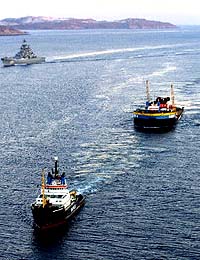
The wreck of the Kursk nuclear submarine, once the pride of Russia’s Northern Fleet, was towed on its final journey on Wednesday into the tiny Arctic port of Roslyakovo to be dismantled.
Scores of townspeople gathered in the pale autumn light to watch as the Giant-4 barge hauled the 18,000-tonne hulk, raised from the seabed in an unprecedented operation on Monday, into the bay against a backdrop of low snow-covered mountains.
Local schools were closed for the day to allow children to attend the event.
Some of the watchers were in tears, perhaps remembering the 118 crewmembers who died when, just 14 months ago, two mysterious blasts sent the submarine to the bottom of the Barents Sea.
But for many the sadness was tinged with apprehension at the thought of the Kursk’s two nuclear reactors and a possible threat of radiation leaks.
When the remains of the Kursk are finally lifted into dry dock following a lengthly operation due to begin on Saturday, experts hope that a thorough examination will reveal the reasons for the disaster, which not only destroyed a submarine but also dealt a body-blow to Russia’s self-esteem.
Russian naval officials have sought to attribute the sinking to a collision with a foreign vessel, but have provided no evidence to support the claim.
A 37-strong team of investigators has arrived in the nearby closed port of Severomorsk, preparing to begin work on determining the causes of the two blasts that ripped through the Kursk’s front section that fateful Saturday, August 12, 2000.
The marathon 65-million-dollar (71-million-euro) lifting operation was ordered by President Vladimir Putin to honour a pledge given to the seamen’s families that their bodies would be recovered for burial.
Twelve bodies were pulled from the wreck on the seabed in a separate operation last November.
Since then the majority view among the seamen’s families has been that the wreck, with the bodies, should be left at sea in accordance with naval tradition.
Now many of Roslyakovo’s 12,000 inhabitants believe that the Kursk’s nuclear reactors, and the delicate operation that will be needed to extract and remove them, present a radioactive hazard, despite government reassurances to the contrary.
Environmental groups and some defence experts have expressed concern about the condition of the Kursk’s 22 Granit missiles and nuclear reactors.
Local residents have already begun taking precautions for the three months that the Kursk is expected to remain in Roslyakovo.
“When I heard that the Kursk would be put in dry dock near where we live, I immediately sent my daughter to my parents’ home in Saint Petersburg. I am sure she will be much safer there than here,” said Svetlana Litovchenko, a 35-year-old secretary.
Many others who have yet to send their children away are themselves thinking seriously of leaving.
“My mother is contemplating renting an apartment in nearby Murmansk, near the airport, so that she can leave the area if anything happens, and many people I know have similar plans,” said Oleg Kachun, a 29-year-old policeman.
Others have sought to protect themselves by buying drugs supposed to help in cases of radioactive contamination.
“We bought iodine for the whole family and a Geiger counter to check the radiation level,” said Tatyana Andronova, a 29-year-old civil servant.
Russian and Norwegian officials monitored the waters around the Kursk for radiation leaks throughout the lifting and towing operation.
Deputy Prime Minister Ilya Klebanov said Tuesday that “if we had the slightest doubt that something might occur with the reactor, we would not continue the operation at Roslyakovo.”
But for all its soothing noises, the Russian navy has prepared a plan to evacuate Roslyakovo’s population to Murmansk and other nearby towns in the event of something going wrong.
Navy chiefs said that even if an accident occurred, the area around Roslyakovo should remain safe because the submarine’s nuclear reactors and weapons were only powerful enough to contaminate the town itself.
All rights reserved. ¿ 2000 Agence France-Presse. Sections of the information displayed on this page (dispatches, photographs, logos) are protected by intellectual property rights owned by Agence France-Presse. As a consequence, you may not copy, reproduce, modify, transmit, publish, display or in any way commercially exploit any of the content of this section without the prior written consent of Agence France-Presse.
