
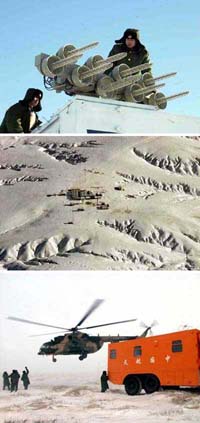
Mission control centers, the land- and sea-based tracking network and the landing recovery team are busy preparing for the return of Shenzhou-4 (SZ-4) later today (Jan. 5), Xinhua News Agency says in the fourth mission status announcement.
The status report says that all science experiments are proceeding as planned, and preparation for the landing continues orderly.
Wen Wei Po in Hong Kong reports today that this afternoon (morning UTC) Beijing Aerospace Command and Control Center (BACCC), the prime mission control centre, will issue a command to separate the Descent Module from the Orbital Module.
The Descent Module will aim to land at the prime landing site before 8pm Beijing Time (1200 UTC).
The Orbital Module will remain in orbit and begin the SZ-4 extended mission to make radar observations of the Earth and collect data on the space environment at the orbiting altitude of the spacecraft.
Returning with the Descent Module are the microgravity fluid physics and life sciences experiments, a variety of seeds, two mannequins — or “analogue humans” in the official jargon — and a host of other items.
Wen Wei Po reported yesterday that the prime landing site would be at the steppe about 40 km from Hohhot, the capital of the Nei Mongol (Inner Mongolia) Autonomous Region.
The target landing site is a narrow area that is about 60 km long and 36 km wide, according to the Wen Wei Po report today.
Last evening (Jan. 4) at 6:28 p.m. Beijing Time (1028 UTC) SZ-4, which had completed 92 orbits at the time, flew past the prime landing site.
The mobile tracking unit from the Xi’an Satellite Control Centre (XSCC) successfully tracked and received data from the unmanned spacecraft there.
The returned data indicated that all flight parameters were nominal.
The environmental indices of the spacecraft, such as temperature, humidity, and oxygen and carbon dioxide concentration, were ideal. The heart rate, respiration and other life indices of the analogue humans were also nominal.
The tracking unit could hear the crisp audio transmission from the spacecraft, a positive sign that the air-to-ground communications system was operating steadily.
The mobile tracking and spacecraft recovery units have been rehearsing at the landing centre in the past few days, despite the harsh frigid weather.
Conditions of the environment at the landing site are worse than any previous Shenzhou landings.
Temperature was at minus 20 deg Celsius when the tracking exercise took place last evening. The overnight temperature from the previous night reached an incredible low of minus 31 C.
A series of snowstorms this winter had turned the landing centre into a sea of snow. Space officials said that it became impossible to tell where the ditches and roads were.
Hostile environment aside, the landing recovery team is ready to receive SZ-4.
At 11:26 a.m. (0326 UTC) yesterday, five search helicopters arrived at the landing centre. Joining the helicopters were a convoy of search and command vehicles.
The ground vehicles and the helicopters will arrive at the target landing area about an hour before the SZ-4 landing and await instructions from BACCC.
Xia Changfa, Chief Commander at the landing centre, said: “The landing centre communications system is normal, conditions of various equipment are good and operating nominally.
The recovery personnel are in high spirits and ready to welcome the triumphant return of Shenzhou-4 at any time.”
