

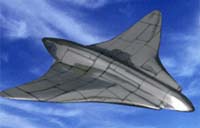
Raytheon Company is developing a revolutionary aircraft structure technology that could change in flight to adapt to mission requirements, targets and other changes in battle.
Raytheon received a $4.1 million contract from the Defense Advanced Research Projects Agency (DARPA) for its work under the Morphing Aircraft Structures program. Raytheon is proposing adaptive wing technology for its cruise missile mission vehicles. Prototypes are scheduled to be tested in early 2005.
Morphing wings is the first in a series of steps to permit a cruise missile to travel at high speeds to a target area, loiter and then move to another target area, with speed changes from 0.3 Mach to 3.0 Mach. The technology ultimately could be applied to other platforms and future air vehicles, manned and unmanned.
DARPA’s Defense Sciences Office is investigating advanced concepts that use integrated design with advanced materials, actuators, sensors and electronics to create devices and adaptive structures that enable significant in-flight vehicle shape change.
These shape changes are more significant than those currently found in flight vehicles, and, in turn, will enable new military capabilities such as those envisioned by Raytheon.
“Raytheon’s Morphing program intends to demonstrate revolutionary capability to allow a single missile to be able to perform multiple missions or the same mission more effectively,” said Donald Uhlir, Raytheon’s Morphing program manager.
“Morphing capability applied to a missile would enable efficient flight at multiple speeds and altitudes without sacrificing performance as is currently the case when operating off the optimized cruise point,” Uhlir said.
Exceptionally quick response to a threat and mission flexibility could mean fewer missiles are needed to destroy a target.
