
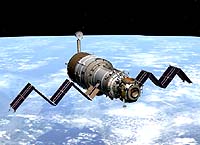
Russia on Wednesday launched the living and working quarters for the International Space Station (ISS) after more than a year’s delay, Russian space center officials said.
A Proton rocket carrying the 19-tonne Zvezda service module blasted of from Russia’s Baikonur cosmodrome in Kazakhstan at 8:56 a.m. (0456 GMT), Konstantin Kreidenko of the Russian Space Agency told AFP.
“Zvezda has successfully reached orbit. The launch was fine and now we are in our second stage,” Kreidenko said by telephone 10 minutes after the launch.
The launch paves the wave for the first US-Russian crew to inhabit the ISS in October.
The 320-million-dollar service module will provide the living and working quarters for ISS crews. The module was financed almost entirely by the Russians, whose space agency is experiencing a severe cash shortage.
But the US fast food giant Pizza Hut is alleviating some of the financial difficulties in return for having its logo emblazoned on the side of the launcher rocket.
The publicity stunt is reportedly costing Pizza Hut one million dollars, the Russian business daily Kommersant reported. The space agency refused to confirm the sum.
A large part of the money will go towards expanding the Khrunishev center, which helps build the launchers.
A report by the US General Accounting Office said there were still a number of safety problems with the module, but the Russian space agency rejected the report.
Spokesman Valery Ryumin said 368 problems had been discovered while testing the module. “Nearly all of the problems have been solved,” said Ryumin.
The Zvedza module is scheduled to dock with the two other elements of the ISS on July 26. The Russian module Zarya and the US-built Unity are already in space.
If the automatic docking fails, two Russian cosmonauts, Gennady Padalka and Nikolai Budarin, will be sent into space on August 10 to manually dock the components.
Zvedza will be responsible for navigating the ISS.
The International Space Station is a project involving 16 countries, including the US, Canada, Japan and Russia. When finished, the complex will be 100 meters (yards) long, and weigh more than 450 tonnes.
