
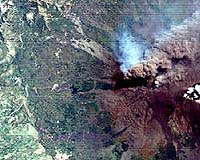
24 hours after the Aetna’s eruption, PROBA, the 1st mini satellite made in Belgium, shoots a picture of the lava and ashes belching volcano.
As soon the PROBA team heard the news of the erupting volcano, the longitude and latitude of the target area were communicated to the satellite as soon as possible. Yesterday morning PROBA took the picture with the Compact High Resolution Imaging Spectrometer (CHRIS) and sent the data to the ESA ground station at Redu with this picture as a result.
Herewith PROBA proves again after one year in orbit to be flexible enough to function quickly and accurately. Verhaert developed PROBA, acronym for Project for On-Board Autonomy, for the European Space Agency ESA. Primary goal of this mission is demonstration of the possibilities and advantages of the on-board autonomy: fulfilling a number of assignments with minimal intervention of the ground station.
PROBA was built by the Kruibeke firm Verhaert for the European Space Agency (ESA), with the support of the Belgian Federal Office for Scientific, Technical and Cultural Affairs (OSTC). To this end Verhaert cooperated with Belgian companies such as Spacebel (on-board software), SAS (Ground station & operations) and OIP (High Resolution Camera and Wide Angle Camera).
At an international level the University of Sherbrooke (Canada) was involved for the Attitude Orbit Control System (AOCS), Patria Finnavitec (Finland) and Contraves (Switzerland) supplied the spacecraft instruments for debris and radiations measurements and Officine Galileo (Italy) delivered the solar panels.
CHRIS is the main payload on board the satellite and was built by the English company SIRA with support of the British National Space Council (BNSC).
