
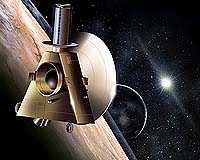
NASA’s New Horizons mission has completed its first major project review, and technical experts from several institutions found the requirements for the first spacecraft to Pluto and the distant Kuiper Belt are well on track.
Now in preliminary development, New Horizons held its Systems Requirements Review May 15-16 at The Johns Hopkins University Applied Physics Laboratory (APL) in Laurel, Md., which manages the mission for NASA and will build and operate the spacecraft. A standard review for all NASA planetary missions, the 2-day session included a comprehensive assessment of New Horizons’ mission plans and spacecraft designs.
“New Horizons has a solid design and is ready to proceed,” says Eric J. Hoffman, the APL space department’s chief engineer, who headed a panel of leading engineers from APL, NASA’s Jet Propulsion Laboratory, Pasadena, Calif., and Southwest Research Institute, San Antonio. NASA Headquarters representatives attended the review but did not participate on the panel.
“The review was the project team’s first chance to show it understood its requirements and was on track to implement the mission,” says New Horizons Project Manager Thomas Coughlin, of APL. “I feel very good about our progress.”
New Horizons is working toward a January 2006 launch and arrival at Pluto and its moon, Charon, as early as 2015. The spacecraft will characterize the global geology and geomorphology of Pluto and Charon, map their surface compositions and temperatures, and study Pluto’s complex atmosphere in detail. It will then visit objects in the Kuiper Belt, beyond the orbits of Neptune and Pluto.
“The Systems Requirements Review confirmed that New Horizons is making progress on spacecraft and scientific instrument design, and that we are ready to proceed toward the mission confirmation reviews that NASA is requesting we hold in September,” says S. Alan Stern, New Horizons principal investigator and director of the Southwest Research Institute’s department of space studies in Boulder, Colo.
