
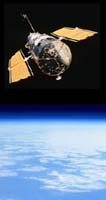
A polymer coating that conducts electricity has been developed by Canadian scientists to help satellites weather solar storms.
Satellites are usually blanketed with insulation to protect them against heat and light damage.
But this non-conducting blanket also allows electrostatic charge from particles streaming from the Sun to build up on the satellite’s skin, leading to arcing that can destroy the craft’s circuitry.
Arcing has been blamed for the loss of two Canadian Anik satellites in 1994 and 1996.
To prevent this, Rui Resendes, Ian Manners and their colleagues at the University of Toronto have developed a polymer called a polyferrocene which has iron atoms bound into its molecular structure.
This makes it electrically conducting. The polymer allows the charge to equalise around the surface of the satellite.
“This is certainly a valid approach. Ultimately it will come down to cost,” says Alan Tribble, an aerospace engineer with Rockwell Collins in Cedar Rapids, Iowa.
This article appeared in the April 1 issue of New Scientist New Scientist. Copyright 1999 – All rights reserved. The material on this page is provided by New Scientist and may not be published, broadcast, rewritten or redistributed without written authorization from New Scientist.
