
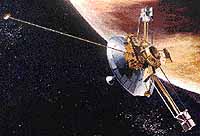
Some 10 light hours out, an aging pioneer that keeps on trucking like an aging ’70s pop star, is slowly slipping away as its plutonium battery trickles down. A recent attempt to re-orient Pioneer 10 now appears to have failed, leaving the distant probe perilously close to the point where all contact may finally be lost.
It appears that a pointing maneuver conducted July 8 and previously reported as successful did, in fact, not take place. With Pioneer 10 seeing a decrease in signal strength. Ric Campo, Pioneer Operations Supervisor says a new attempt will be made. “We are looking for an appropriate time to re-command the maneuver.”
“Until that time we will continue to track the spacecraft one or two times a month. As Earth swings back into the spacecraft field of view, the signal level will improve until mid November when the spacecraft will once again be at a small Earth Look Angle,” reported Campo.
The Radioisotope Thermoelectric Generators (RTGs) continue to provide sufficient power to support the current spacecraft load of transmitter, receiver, command and data handling as well as the Geiger Tube Telescope (GTT) science instrument.
The RTGs are currently providing approximately 65 Watts of power (about 42% of the 155 Watts launch value).
The science and transmitter are turned off to provide enough power to fire the attitude control engines for the biannual spacecraft pointing maneuvers towards the Sun (the latest maneuver was executed on 2/11-12/00).
The battery voltage is often discharged and charged. However, the battery does not support any of the load, being charged to only about 1 volt at its peak, down from its nominal value of 9 volts.
The Bus Voltage is at a steady 27 Volts with a Bus Current of about 1.3 Amps.
The platform temperature is still within acceptable limits at -41 degrees F (the nominal range is between -63 F to 180 F).
The Deep Space Network (DSN) continues to provide good data with the received signal strength of -178 dBm (only a few dBm from the receiver threshold of -180 dBm).
Although powerwise Pioneer 10 is operating OK with one science instrument on, the DSN may not be able to get good telemetry lock as the signal-to-noise ratio (SNR) continues to decrease. Even though in a year the DSN may still be able to get good telemetry lock, being this close to the receiver threshold and losing about 0.3 dBm/yr due to range, maintaining contact will be a challenge.
From a typical tracking report of late:
