
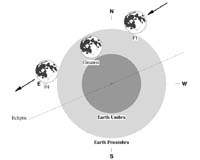
The first lunar eclipse of 2006 is a deep penumbral event best visible from Europe and Africa. First and last penumbral contacts occur at 21:22 Universal Time and 02:14 UT on Tuesday, respectively. Observers throughout most of North America will find the eclipse already in progress as the Moon rises on the evening of March 14.
However the event will not be visible from westernmost North America, including Canada’s Yukon and British Columbia provinces, and the states of Alaska, Washington, Oregon and California. The event will end in those areas before moonrise.
NASA scientists said this particular event is unusual because it is a total penumbral eclipse, meaning the whole Moon will lie completely within the penumbral – or outer portion – of Earth’s shadow from 23:18 Universal Time Tuesday to 00:18 UT Wednesday.
Belgian eclipse expert Jean Meeus said this will be one of only five such events during the 21st century.
The deepest period of eclipse occurs at 23:48 Universal Time, with a penumbral magnitude of 1.0565. At that instant, the Moon will stand midway in the penumbral shadow. The Moon’s northern limb will lie 1.6 arc-minutes from the shadow’s outer edge while the southern limb be 1.6 arc-minutes from the edge of the umbra.
Penumbral eclipses are difficult to observe, particularly during their early and late stages. Nevertheless, viewers on the ground should see subtle but distinct shading across the southern half of the Moon, most prominent during the two-hour period centered on greatest eclipse.
