
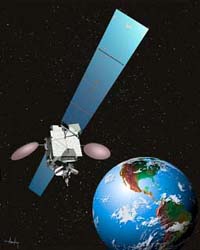
PanAmSat said today that its PAS-9 Atlantic Ocean Region satellite has arrived at Sea Launch Home Port in Long Beach, Calif., in preparation for a late-July liftoff.
Following integration with a Zenit-3SL rocket, the PAS-9 spacecraft will be transferred to Sea Launch’s Odyssey Launch Platform, where it will blast off into space from the equator in the Pacific Ocean.
The high-powered PAS-9 spacecraft will be located at 58 degrees west longitude, offering PanAmSat customers worldwide advanced video distribution, Internet and data services throughout the Americas, the Caribbean and Europe.
“The deployment of PAS-9 will reaffirm PanAmSat’s leadership in the delivery of satellite-based services throughout the Atlantic Ocean Region, specifically in Latin America,” said Robert A. Bednarek, PanAmSat’s executive vice president and chief technology officer.
“With the launch of PAS-9, PanAmSat’s investment in the region will reach nearly $2 billion, demonstrating our commitment to meeting the continued strong demand for satellite-delivered communications services in Latin America, our second largest market after the United States.”
PAS-9 will operate at 58 degrees west longitude, taking over for PanAmSat’s PAS-5 Atlantic Ocean Region satellite. PAS-9 will also serve as the permanent platform for Sky Mexico’s DTH service, offered through a partnership formed by Grupo Televisa, The News Corporation and Tele-Communications International, Inc. The DTH service will employ 12 Ku-band transponders on PAS-9 to digitally deliver television channels directly to consumers’ homes throughout Mexico, Northern Central America and parts of the Caribbean.
Concurrently, PanAmSat updated its launch schedule by announcing that the PAS-1R Atlantic Ocean Region satellite will be launched in the fourth quarter 2000 and the PAS-10 Indian Ocean Region spacecraft will be launched in the first quarter 2001.
PanAmSat expects that the current PAS-1R and PAS-10 launch dates will not have a material impact on the company’s projected 2000 or 2001 financial results, primarily because the satellites are intended as replacements for existing spacecraft, which will continue to produce revenue.
Based upon information provided by the satellite manufacturer Hughes Space and Communications Co. (HSC), the following chart outlines PanAmSat’s current launch schedule and the expected in-service dates of the planned satellites. The company’s launch providers have indicated that they can accommodate the current launch schedule.
Satellite       Model      Launch Date In-Service Date Launch Provider
PAS-9           HS 601 HP  3Q 2000      3Q 2000        Sea Launch
PAS-1R          HS 702     4Q 2000      4Q/Q1 2000/1   Ariane 5
PAS-10          HS 601 HP  1Q 2001      2Q 2001        Proton
Galaxy IIIC     HS 702     2Q 2001      3Q 2001        SeaLaunch
