
Team Vandenberg is scheduled to conduct the inaugural launch of an Orbital Suborbital Program Space Launch Vehicle, Jan. 14, 6:54 p.m. to validate the vehicle’s spacelift ability. The launch window is scheduled from 6:54 to 9:54 p.m.
To determine the mission’s success Air Force personnel will evaluate data measuring the successful separation of the payloads and their ability to be deployed into the correct orbit.
The OSPSLV is the result of combining a Minuteman II first and second stage rocket motor and a Pegasus XL third and fourth stage rocket motor.
The Minuteman II was initially used by the Air Force as an Intercontinental Ballistic Missile. It was later deactivated as an offensive weapon system by the Strategic Arms Reduction Treaty in 1991. The creation of the OSPSLV rocket is part of an Air Force effort to use surplus Minuteman II components for spacelifting payloads into polar orbit.
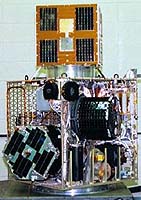
The payloads for the upcoming launch are integrated to the Joint Air Force Academy Weber State University, or JAWSAT, multi-payload adapter. The four payloads are the U.S. Air Force Academy’s FalconSat, Arizona State University’s ASUSAT, Stanford University’s OPAL satellite and the Air Force Research Laboratory’s Optical Calibration Sphere Experiment.
Also attached to the multi-payload adapter are two experiments: NASA Marshall Space Flight Center’s Plasma Experiment Satellite and Weber State University’s Attitude Controlled Platform.
Previous Jawsat Report at SpaceDaily
Scheduled for launch on December 7, 1999 the JAWSAT Multi-Payload Adapter (MPA) space-frame will deploy four independent satellites, including:
- ASUSAT
from Arizona State University - Opal, a satellite from Stanford University
- The United States Air
Force Academy‘s Falconsat satellite - An Optical Calibration Sphere Experiment from the Air Force Research Laboratory under contract to L’Garde, Inc.
JAWSAT will also support two other experiments that will remain attached to its MPA frame:
- PEST,
NASA Marshall Space Flight Center‘s Plasma Experiment Satellite Test - Weber State University’s Attitude Controlled Platform
(ACP)
