

The U.S. Air Force Space and Missile Systems Center has awarded Orbital Sciences a $5 million contract for the Quick Reaction Launch Vehicle-2 (QRLV-2) program.
QRLV-2 is the first task order executed under the Air Force’s Sounding Rockets Program-2 (SRP-2) indefinite delivery/indefinite quantity contract, which allows Orbital and three other qualified companies to compete for up to $96 million in task order launch services.
For the QRLV-2 program, Orbital will design, produce, integrate and launch a single-stage, guided suborbital rocket. Orbital’s Launch Systems Group, which is responsible for the company’s space and suborbital launch programs, will carry out the QRLV-2 activities at its engineering and manufacturing facility in Chandler, Arizona. The launch itself is planned for March 2002 from the Kodiak Launch Complex in Alaska.
“We are extremely pleased that the Air Force selected us in a highly competitive procurement to perform the first launch services task order under the SRP-2 contract,” said Mr. Ronald J. Grabe, Executive Vice President and General Manager of Orbital’s Launch Systems Group.
“We look forward to building on the successful relationship we developed with the Air Force under SRP-1 and in providing them with additional highly reliable launch services.”
The Air Force’s Sounding Rockets Program supplies target vehicles that are used to test interceptor missiles and are also used by other U.S. Department of Defense agencies for special-purpose missions.
The SRP-2 contract is a follow-on to the Air Force’s SRP-1 contract under which Orbital competed for and won task orders to provide nine Navy Theater Wide (NTW) target vehicles, the atmospheric intercept test-1 (ait-1) vehicle, and the Quick Reaction Launch Vehicle-1 (QRLV-1), which is scheduled for launch in March 2001 from the Kodiak Launch Complex.
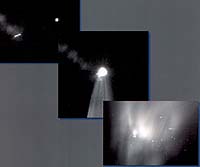
The contract follows the successful launch of a suborbital rocket that collected optical and radar data for the U.S. Army’s Theater Missile Defense (TMD) Critical Measurements Program (TCMP) that was conducted last week.
Orbital’s Launch Systems Group in Chandler, Arizona was responsible for the design, production, test, integration and launch of the TCMP program launch vehicles, which is overseen by the U.S. Army Space and Missile Defense Command.
With sponsorship from the Ballistic Missile Defense Organization (BMDO), TCMP aims to reduce TMD system development risk by characterizing reentry and potential countermeasures behavior in and out of the atmosphere.
