
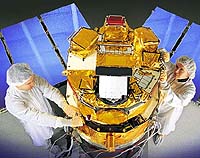
Orbital Sciences says it is in final preparations to launch the U.S. Air Force’s Tri-Service Experiments Mission 5 (TSX-5) satellite aboard its Pegasus rocket.
The launch is scheduled for Wednesday morning, June 7, 2000. The available window for the mission extends from 6:02 a.m. to 7:00 a.m. (PDT).
This schedule is subject to the completion of final pre-launch testing, as well as acceptable weather conditions at the Vandenberg Air Force Base (VAFB), California launch site.
The TSX-5 mission will be the first Pegasus mission of 2000 following three consecutive years of flawless performance, as well as the 29th launch overall in the rocket program’s history.
On launch day, the powered flight sequence for the TSX-5 mission is expected to take approximately 14 minutes, from the time the Pegasus rocket is released from its L-1011 carrier aircraft to the time that the TSX-5 satellite is deployed into its targeted elliptical orbit.
Following the launch, Orbital expects that it could take several hours before reliable data, gathered by ground tracking stations as the satellite passes overhead, can be assembled and reported on the basic status and health of the spacecraft.
Under a contract from the U.S. Air Force, Orbital designed and built the 250-kg TSX-5 satellite at the company’s Washington, D.C. metropolitan area satellite manufacturing facilities, and will provide technical support during the one-year mission.
The TSX-5 spacecraft carries two research experiments intended to demonstrate advanced space technologies. Orbital has previously developed numerous spacecraft for Air Force space research missions, including APEX, REX II and the STEP series of small satellites.
