
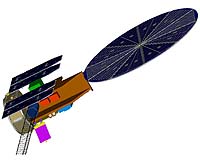
Orbital Sciences announced Monday that it has been selected by NASA’s Jet Propulsion Laboratory to design, develop and manufacture the next satellite in the NASA’s series of New Millennium Program (NMP) technology demonstration spacecraft.
The satellite, Space Technology 8 (ST8), will be based on Orbital’s Microstar platform, a lightweight, multi-role spacecraft bus of which dozens are already in orbit performing communications and Earth and space science missions. At launch, ST8 will weigh approximately 385 lbs. (or 175 kg).
In addition to the satellite contract, Orbital will also provide the mission’s launch vehicle and related services, which is procured by NASA’s Kennedy Space Center under a separate contract. The ST8 mission will utilize Orbital’s highly reliable Pegasus rocket, the world’s leading small launcher for dependable transportation to low-Earth orbit. Together, the total value to Orbital of the ST8 program is expected to exceed $50 million.
The ST8 mission is a technology demonstration mission, consisting of four payload experiments. Together, these experiments aim to improve NASA’s understanding of the feasibility of using these technologies for future space missions such as large solar sail missions. The four technology demonstrations include a large flexible solar array, a 40-meter deployable boom, high radiation environment electronics and a thermal radiator experiment.
The ST8 mission is scheduled for launch in early 2009 and is planned to conduct a seven-month technology demonstration mission. Orbital’s overall role is to provide the spacecraft, perform the integration of the experiments with the satellite platform, conduct pre-launch environmental testing, integrate and test the satellite with the launch vehicle, plan and conduct the mission’s launch operations and provide post-launch mission operations support.
