
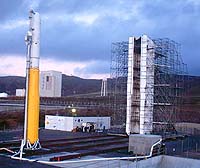
Orbital Sciences said it will o launch the U.S. Air Force’s MightySat II satellite and DAPRA’s PicoSat aboard a Minotaur rocket on Wednesday, July 19, 2000 between 1:09pm to 2:35pm PDT (2009 to 2135 GMT).
The MightySat II mission represents the second launch of the Minotaur rocket, which successfully delivered 11 small satellites into their targeted orbits on its inaugural flight in January 2000.
Orbital developed the four-stage Minotaur rocket for the Air Force’s Orbital/Suborbital Program (OSP) using U.S. Government-supplied Minuteman II motors that have been decommissioned as a result of arms reduction treaties.
The deactivated rocket motors serve as the vehicle’s first and second stages. Its third and fourth stages, as well as its guidance and control system, use technology from Orbital’s Pegasus XL rocket.
Orbital is under contract to the Air Force to provide integrated Minotaur launch vehicles and to perform launch operations to deliver small military satellites to orbit.
On launch day, the available window for the Minotaur mission extends from 4:09 p.m. to 5:35 p.m. Eastern time, with a targeted launch time of 4:09 p.m. This schedule is subject to the completion of final pre-launch testing, as well as acceptable weather conditions at the Vandenberg Air Force Base (VAFB), California launch site.
The operational sequence for the mission is expected to take about 11 minutes, from the time the Minotaur launcher’s first stage engine ignites to the time that the satellite payload is deployed.
The Minotaur rocket is expected to deliver the satellite into a circular, sun-synchronous orbit approximately 297 nautical miles [550 kilometers] above the Earth, inclined at 97.6 degrees to the equator.
The 263-pound [120-kilogram] MightySat II satellite was built by Spectrum Astro, Inc. of Gilbert, Arizona for the Air Force Research Laboratory (AFRL).
A follow-on to the Orbital-built MightySat I satellite, which was successfully launched from the Space Shuttle in late 1998, MightySat II will provide a space-based platform for demonstrations of advanced AFRL space system technologies such as a solar array concentrator and a Fourier Transform Hyperspectral Imager.
