
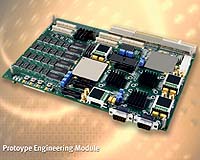
Orbital Sciences Corp. has selected Maxwell’s SCS750 single board computer (SBC) to manage payload data for NASA’s Glory earth sciences mission.
Glory is a three-year mission that will investigate the composition of greenhouse gases and the effect of solar radiation on the earth’s environment. Orbital is building the satellite bus and will manage the 2008 launch and control the spacecraft for the duration of the mission. Glory’s payloads will include an aerosol polarimetry sensor and cloud cameras to collect visible and infrared data, and a total irradiance monitor to measure solar radiation.
Larry Longden, Maxwell’s director of technology and marketing, said that the SCS750’s industry-leading processing power will allow Orbital to manage all of the satellite’s data management functions, and that Maxwell’s proprietary component shielding technology and system-level architecture enable the SBC to withstand the effects of environmental radiation to provide error-free performance in space.
“The Maxwell SCS750 was the best fit for reliability, function, and cost for the Glory needs,” said Tom Itchkawich, the Glory Program Director. “We feel that this will be an excellent processor solution that will give us the flexibility to accommodate future growth in mission requirements.”
The SCS750 is based on a “triple modular redundancy” architecture in which three commercial IBM PowerPC 750 processors run the same program at all times and “vote” on each operation. If one of the processors suffers a radiation-induced upset and disagrees with the other two, the system is automatically resynchronised and resumes error-free operation. Maxwell’s proprietary shielding and packaging technology protect other components on the board from radiation effects.
