
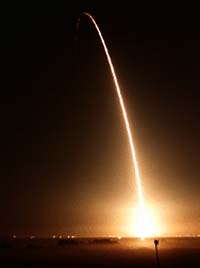
An Orbital Sciences Taurus XL successfully launched the Republic of China’s ROCSAT-2 remote sensing satellite into low-Earth orbit in a mission that originated from Vandenberg Air Force Base in California on May 20.
The mission was the seventh in the Taurus program’s history and was also the inaugural flight of the enhanced performance “XL” version of the space launch vehicle.
At approximately 1:47 p.m. (EDT), following the ignition of the Taurus first stage motor, the rocket lifted-off from launch pad 576E at Vandenberg and flew its trajectory over the Pacific Ocean.
Approximately 14 minutes later, the ROCSAT-2 satellite separated from the final stage of the Taurus booster and was placed into orbit approximately 735 kilometers above the Earth, inclined at 99.1 degrees to the equator.
Preliminary results indicate that the ROCSAT-2 satellite is operating as planned in the early stages of its mission.
Mr. Ron Grabe, Orbital’s Executive Vice President and General Manager of its Launch Systems Group, said, “We are very pleased with the results of the Taurus launch and wish our customers from Taiwan’s National Space Programs Office the very best with their satellite mission.
This launch sets the stage for Orbital’s continued support for the ROCSAT program. As the prime contractor for the upcoming ROCSAT-3 constellation of six small satellites, as well as the launch vehicle provider for that mission, we look forward to contributing to the continued success of the National Space Program Office’s space missions.”
