

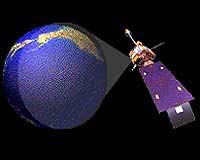
Orbital Sciences Corporation said Monday that it has been awarded a $2 million contract by the National Oceanic and Atmospheric Administration (NOAA) to conduct studies of potential space and ground system architectures for the next generation of the Geostationary Operational Environmental Satellite (GOES) system known as GOES-R.
The GOES-R system will use geostationary (GEO) satellites, equipped with advanced remote sensing instruments, to conduct environmental monitoring and weather forecasting activities for the U.S. Government and scientific community.
Under the contract, Orbital will develop concepts that will allow NOAA to meet its future requirements for environmental sensing, data collection and data distribution. Orbital will complete studies for the GOES-R system’s Space and Launch segment, its Command, Control and Communications (C3) segment, and its End-to-End Systems Integration segment.
“Orbital is very excited to be selected to assist NOAA in determining the most effective space and ground system to meet its future needs for the GOES system,” said Mr. David W. Thompson, Orbital’s Chairman and Chief Executive Officer.
“We look forward to applying Orbital’s broad experience in developing innovative approaches to U.S. Government Earth observation missions for this critical NOAA program.”
Mr. Jack Danko, Orbital’s Executive Vice President and General Manager of its Space Systems Group, stated, “Orbital’s experience in designing complete space and ground systems for both low-Earth and geostationary orbit spacecraft gives us the background to make meaningful contributions to NOAA’s GOES-R program. We will use our proven ability to design cost-effective, flexible and low risk architectures in support of NOAA’s initiative.”
