

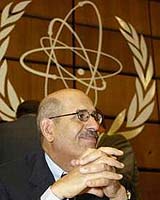
Tighter global controls on the export of nuclear material and technology must be included in a bolstered nuclear non-proliferation treaty (NPT) up for debate next year, the head of the UN nuclear watchdog said Thursday.
International Atomic Energy Agency chief Mohamed El Baradei insisted in an article for a UN review that the multilateral treaty – whose effectiveness has been questioned by the United States – remained “the essential anchor” for global nuclear non-proliferation and disarmament.
Its weaknesses in the face of the advancing availablity of nuclear weapons know-how – now thought to extend to 40 countries – should be tackled by bringing more countries on board a stronger NPT at a review conference due in 2005, he added.
“The nuclear export control system should be universalised and treaty-based, while preserving the inalienable rights of all states to peaceful nuclear technology,” El Baradei wrote.
One hundred and eighty-eight countries have joined the 1970 NPT limiting the spread of nuclear weapons, including the five main nuclear superpowers, but not emerging weapons states India, Pakistan, or Israel.
North Korea pulled out last year.
India earlier this month repeated that it was not ready to sign the Non-Proliferation Treaty, saying the pact imposes stricter conditions on fledgling nuclear states than on established nuclear powers.
However, the NPT’s system of checks on technology and material exports are not binding, and only 61 of the signatories have subscribed to them.
The flaw was one of the triggers for the current tensions between Iran and the IAEA over its enrichment facilities.
The United States has also accused countries of seeking nuclear weapons capability while under the cloak of the NPT.
El Baradei said nuclear inspectors must have the right to conduct checks in all countries, while transparent limits must be placed on processing of plutonium and weapons grade enriched uranium.
No country should be allowed to bow out of the NPT “without clear consequences” before the UN Security Council, he added, rejecting the current allowance for three months notice.
North Korea withdrew from the NPT in 2003 after it revived the Yongbyon nuclear reactor, marking the first time any country has withdrawn from a multilateral arms control treaty.
The move raised international tensions and prompted warnings of “nuclear anarchy”.
