
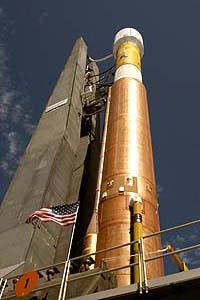
Northrop Grumman has won a contract to develop the critical first step for a new upper-stage rocket engine designed to eventually succeed the RL-10 that has helped lift spacecraft into orbit for nearly 40 years.
Under a contract from the U.S. Air Force Research Laboratory (AFRL) at Edwards Air Force Base, Calif., for the Upper Stage Engine Technology (USET) program, the company’s Space Technology sector will create software tools that will be used to design a 40,000-pound thrust-class engine that uses liquid oxygen and liquid hydrogen as propellants.
“Northrop Grumman Space Technology has developed innovative propulsion technologies for more than 40 years,” said Tom Romesser, vice president of technology development for Northrop Grumman Space Technology. “We will use our considerable propulsion systems engineering expertise to develop a set of enabling tools that will provide a more capable upper-stage engine to help ensure our country’s continuing viable access to space.”
The Air Force has established Integrated High-Payoff Rocket-Propulsion Technology goals to double space- and missile-propulsion capability while significantly decreasing manufacturing cost and maintenance cost by 2010.
This program ultimately will demonstrate all technologies by hot-fire testing in five years. Northrop Grumman Space Technology was awarded a $2.6-million, nine-month contract for the beginning phase of USET. The contract potentially is worth $44 million if all testing options are exercised.
Northrop Grumman Space Technology and its team members will work with the Air Force and the AFRL in an integrated product team environment to develop this capability. Team members are Allison Advanced Development Company, Indianapolis, Ind.; Concepts NREC, White River Junction, Vt.; Barber-Nichols Inc., Arvada, Colo.; Texas A&M University, College Station, Texas; Sierra Engineering Inc., Carson City, Nev.; and D&E Propulsion and Power Inc., Mims, Fla.
The company’s leading-edge propulsion technologies range from tiny microthrusters for on-orbit stationkeeping to a 650,000-pound-thrust engine for low-cost space transportation. These systems have delivered astronauts to the moon, propelled space probes around outer planets, and kept low-Earth and geosynchronous orbiters pointed and steady.
