

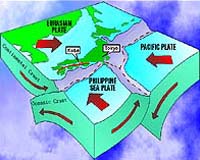
A Japanese geologist has discovered a new tectonic plate under the Tokyo area, a finding that may force the government to review its quake preparation plans, a report said Saturday.
Japan endures 20 percent of the world’s powerful earthquakes as the country lies at the crossing of four tectonic plates – the Eurasian, North American, Philippine and Pacific plates.
If a quake measuring 7.3 on the Richter scale were to hit the Tokyo region in the evening rush hour, it would kill 13,000 people and inflict 1.1 trillion dollars in damage, according to a government estimate released in February.
The geological structure of the Kanto region, which includes Tokyo, is complex with the interaction of the Philippine, Pacific and Eurasian plates, but Shinji Toda argued the portion of a plate believed to be part of the Philippine plate was indeed an independent tectonic plate, Kyodo News Agency said.
Toda, chief researcher at the Active Fault Research Center of the National Institute of Advanced Industrial Science and Technology, said he analyzed data on 150,000 quakes with magnitudes above 2.0 between 1979 and 2004 in the Kanto region, Kyodo said. He is to present his findings at a meeting on Sunday.
If Toda’s findings are confirmed, Japan “may need to review its earthquake-related policies around Tokyo” since such polices are made on the assumption the Philippine plate is a single tectonic plate, Kyodo said.
“We need to fundamentally review our understanding of earthquake mechanisms, including the structure of tectonic plates,” Toda was quoted by Kyodo as saying.
The previous big quake that hit the Kanto region occurred in 1923, leaving 142,807 people dead or unaccounted for.
In January 17, 1995, the western Japanese city of Kobe experienced a pre-dawn tremor, registering 7.3 on the Richter scale, that killed 6,433 people.
The Kobe quake was the most devastating in modern times to hit a city in the developed world.
