
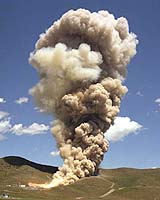
An insulation design change that will further enhance the safety of the Space Shuttle’s Solid Rocket Motor nozzle is set for its final certification test on a static firing of a full-scale flight support motor Thursday, Jan. 23, at a Utah test facility.
Results from the test – to be conducted at the Promontory, Utah, facilities of ATK Thiokol Propulsion, an Alliant Techsystems Inc., company — will be used to qualify a new insulation design on the motor’s nozzle to case.
The new design will improve flight safety and help reduce costs on the motor, according to Jody Singer, project manager of the Reusable Solid Rocket Motor Project Office at NASA’s Marshall Space Flight Center in Huntsville, Ala.
Static — or stationary – firings of flight support motors are part of Shuttle’s ongoing verification of components, materials and manufacturing processes required by the Space Shuttle program. Flight support motors are tested annually to evaluate, validate and qualify any proposed upgrades or changes to the motor.
The two-minute test duration is the same length of time that the motors perform during Shuttle flights.
On this motor, there are 97 objectives and a total of 459 instrumentation channels being tested. There are 10 principal objectives for the test of Flight Support Motor-10.
“Full-scale static testing is a key element in our program,” said Singer.
“The rule is: Everything we fly, we static test first.”
The test will be conducted in the T-24 bay of the Thiokol test facility, north of Salt Lake City. Following the test, the data will be analyzed and the results for each objective provided in a final report. The metal case segments and nozzle components will be refurbished for reuse.
At 126 feet (38.4 meters) long and 12 feet (3.6 meters) in diameter, the Shuttle’s Reusable Solid Rocket Motor is the largest solid rocket motor ever flown and the first designed for reuse. During its two-minute burn at liftoff, each motor generates an average thrust of 2.6 million pounds (1.2 million kilograms).
Marshall Space Flight Center has the responsibility for research, technology maturation, design, development, and integration for space transportation and propulsion systems. This includes both the reusable space transportation systems for Earth-to-orbit applications, as well as vehicles for orbital transfer and deep-space transportation.
