
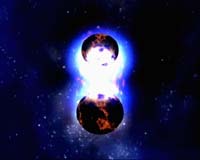
Scientists said Thursday they have recreated in computer simulations what appear to be the strongest magnetic fields in the universe – trillions of times more powerful than Earth’s magnetic field.
The scientists, from The University of Exeter in England and the International University in Bremen, Germany, said the gigantic concentrations of magnetism seem to be related to the phenomenon known as short gamma-ray bursts, which produce some of the momentarily brightest in gamma-ray light explosions in the universe.
The gamma-ray bursts, in turn, are caused by the collisions of two neutron stars collapsed bodies with masses greater than the Sun, but shrunk to spheres only about 20 miles (32 kilometers) in diameter.
“We have managed to simulate, for the first time, what happens to the magnetic field when neutron stars collide, and it seems possible that the magnetic field produced could be sufficient to spark the creation of gamma-ray bursts,” said Daniel Price of Exeter. “Gamma-ray bursts are the most powerful explosions we can detect, but until recently little to nothing has been known about how they are generated.”
Reporting in the March 31 issue of Science, Price and co-author Stephan Rosswog of IU said although it had been thought short gamma-ray bursts require super-strong magnetic fields, no one had shown how energies of the required intensity could be created. So they created computer simulations that mimic the observed phenomena.
“What really surprised us was just how fast these tremendous fields are generated – within one or two milliseconds after the stars hit each other,” Price said.
“Even more incredible is that the magnetic field strengths reached in the simulations are just lower limits on the strengths that may be actually be produced in nature,” Rosswog said. “It has taken us months of nearly day and night programming to get this project running – just to calculate a few milliseconds of a single collision takes several weeks on a supercomputer.”
The remnants of supernovae, neutron stars form when massive stars run out of nuclear fuel and explode, shedding their outer layers and leaving behind a small but extremely dense core. When two neutron stars begin orbiting each other, they spiral slowly together, eventually causing a massive collision that generates a huge amount of magnetic energy and spews enormous gamma-ray emissions the short gamma-ray bursts.
