
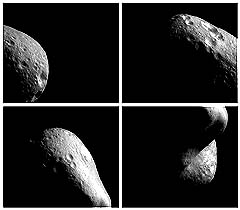
According to the latest science update from the NEAR team at John Hopkins, “Fabulous data are streaming in, and Eros is turning out to be as geologically diverse and fascinating as anyone could have hoped,” said Project Scientist Andrew Cheng in a report issued by JHU on Tuesday.
The new images have once again driven home a lesson that scientists have learned many times before – whenever we obtain new observations at a significantly higher resolution, we learn something new.

“We have an excellent example in the region of Eros discussed in the updates for February 14 and February 8, 2000. The crater discussed on February 8, seen in the image-of the-day for February 7, frame 11:09:45, is the very same crater that appears at the center of the image for February 14
“In the earlier image, taken at a distance of 7700 km, the crater appeared to be perfect, in the sense of having an (apparently) perfect bowl shape with a prominent rim.
“In the later image, taken at 330 km distance giving 23 times higher resolution, we can see that the crater is decidedly imperfect. It is all the more beautiful for its blemishes – the boulder lying in the bowl, the evidence for underlying layered structure, the grooves crosscutting the rim,” reported Cheng.
It is also evident in the February 14 image-of-the-day, as well as that for February 15, that there are bright patches on the surface at scales of a kilometer or smaller. I have yet to hear anyone on the team hazard a guess as to what these are, added Cheng
