
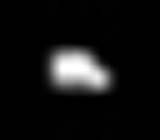
During the next month as NEAR approaches at about 75 kilometers an hour the asteroid will appear progressively larger in images returned from the spacecraft. As a result science operations are now moving into high gear. Each day since Sunday, images of Eros have been successfully obtained.
These distant image sequences had three objectives: to confirm the location of Eros in the sky as seen from the spacecraft, to search for satellites of Eros, and to measure its brightness variations.
This is done to see whether Eros is in the expected part of the sky so as to confirm that NEAR is headed in the proper trajectory — a process called ‘optical navigation’.
NEAR is also on the lookout for any natural moons in orbit about Eros. No moon have been detected about Eros, but several have been found in orbit about the asteroids Ida and Eugenia.
If Eros has a moon, it’s critical as much information is gathered on it before NEAR enter orbit. Of course, once NEAR goes into orbit around Eros, it will become the first artificial moon of an asteroid.
Brightness variations of Eros — called ‘lightcurve’ measurements — are also underway. Eros is an elongated, kidney-bean shaped object as it rotates, greater areas are lit by the sun and Eros appears brighter, but sometimes smaller areas are lit and Eros appears dimmer.
Especially large lightcurve variations are observable when Eros rotates between broadside to the sun and narrow end to the sun — Eros is not in that geometry now, but will be later this year. Eros lightcurve observations are then used to refine our knowledge of Eros’s rotation.
The other instrument teams on NEAR have also been busy. The laser rangefinder test mentioned last week was completely successful There was also a successful calibration of the near infrared spectrometer.
On February 14 NEAR is scheduled to fire its thrusters and begin to orbit Eros, becoming the first artificial satellite of any asteroid.
This article is partially based on NEAR Science Report
