
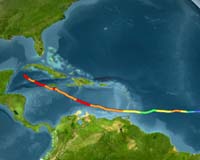
NASA’s Stennis Space Center in Mississippi and the Michoud Assembly Facility in New Orleans are preparing to ride out Hurricane Ivan as it comes ashore on US Gulf Coast. NASA has made preparations to secure important space flight hardware against damage.
Current forecasts have Ivan making landfall overnight Wednesday into Thursday morning. Please visit the National Hurricane Center for the latest forecasts and tracks.
Stennis, where Space Shuttle engines are tested before flight, is about 45 miles inland near the Mississippi-Louisiana border and is home to about 300 NASA personnel and 1,250 NASA contractors as well as employees from other agencies.
Workers there were sent home Tuesday, Sept. 14 to prepare for the storm, and the center is not expected to open before Friday, Sept. 17.
Information for Stennis employees will be posted on as it becomes available.
A team of about 50 essential personnel will ride out the storm at Stennis. Two flight-qualified Space Shuttle Main Engines at Stennis have been secured; one was put back into its container, and the other was wrapped in plastic.
Two developmental engines were enclosed on their test stands and protected.
A ride-out team will also remain in place through the storm at Michoud, across the Mississippi-Louisiana border about 40 miles to the southwest of Stennis.
The NASA facility, operated by Lockheed-Martin, manufactures and assembles the large Space Shuttle external fuel tanks, and is home to about 3,900 employees from NASA, Lockheed-Martin and other agencies.
Lockheed Martin and NASA workers were dismissed Tuesday, Sept. 14. to make preparations at home, and the facility is not expected to open before Friday, Sept. 17. Contact information for Michoud employees is available at http://www.nasa.gov/marshall.
The shuttle fuel tanks at Michoud have been secured. Equipment has been moved indoors, facilities have been sandbagged, and important materials – such as insulating foam and adhesive – have been loaded onto trucks to be transported out of the area, if necessary.
NASA’s Marshall Space Flight Center, located well inland in Huntsville, Ala., is taking normal precautions and making preparations for possible tornados and other effects from Ivan.
Other NASA installations, from Johnson Space Center, Houston, to Kennedy Space Center, Fla., are also keeping a wary eye on Ivan’s track.
“We really saw our readiness for hurricanes Charley and Frances pay off,” said William Readdy, NASA’s associate administrator for space operations.
“KSC was in the path of those two strong storms, and while some of our buildings were damaged, we made sure our workforce was safe and had no injuries. We were also able to protect our three Space Shuttles, our International Space Station components, and other key hardware.”
“Ivan looks like it may be an even more powerful storm, so it’s important that we do everything we can to prepare our people and our facilities.”
