
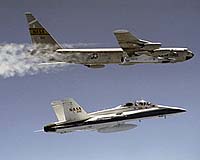
NASA on Monday will conduct the final and fastest test flight of its pilotless X-43A hypersonic research aircraft, aiming to send it zooming across the Pacific Ocean at about 10 times the speed of sound – almost 3.2 kilometers (two miles) per second.
If the test is successful, it will beat the record set in March by another X-43A, which powered up its scramjet engine and performed “flawlessly” for 11 seconds, attaining speeds of seven times the speed of sound, or Mach 7.
Scramjet stands for supersonic combustion ramjet, a new type of engine that burns fuel in a stream of air compressed by the forward speed of the aircraft.
Conventional jet engines use rotating blades to draw in and compress air, and cannot obtain supersonic speeds.
NASA says that ultimately scramjets will provide safer and more affordable high speed flight in vehicles more like airplanes than rockets. Unlike rockets, scramjets can be throttled back and flown like an airplane.
The US space agency on Friday confirmed that the test flight will be launched from southern California on Monday, weather permitting.
A B-52B heavy launch aircraft will take off from California’s Edwards Air Base at 1 pm (2100 GMT) carrying the X-43A and a Pegasus booster rocket under its right wing to an altitude of 12,000 meters (40,000 feet).
The X-43A and its booster will then separate from the B-52B and launch to an altitude of 29,000 meters (95,000 feet), where the scramjet engine will ignite, propelling the X-43A at Mach 10, or 7,000 miles per hour, for about 10 seconds.
The plane will perform a series of preprogrammed maneuvers for about 10 minutes before splashing down in the Pacific Ocean in a repeat of the scenario of last March.
The X-43 is a small machine, just 3.65 meters long, with a wingspan of 1.5 meters.
The 230 million dollar (177 million euro) project spans 20 years of research. Other countries including France and Japan are also exploring scramjet technology.
The X-43A is the first ramjet aircraft capable of drawing its oxygen fuel directly from the atmosphere as it travels at very high speed, as opposed to rockets, which must transport huge tanks of oxygen to create combustion by mixing it with hydrogen.
NASA has built three X-43s. The first had to be destroyed in flight in June 2001. The second broke the world speed record on March 27, 2004.
NASA has had to modify the last member of its X-43 fleet to withstand the temperatures expected at Mach 10 due to air friction.
The nose and forward edge of the wings will hit 2,000 degrees Celsius (3,632 degrees Fahrenheit) – roughly twice the temperatures reached during the flight in March.
NASA officials say the success of the historic March 27 flight has already proven that the technology can be further developped.
The US Air Force is seeking to develop an airplane capable of reaching any point on the globe in less than two hours while transporting six tonnes of bombs or cruise missiles.
The Pentagon and the Australian Defense Ministry plan to test another scramjet-powered vehicle at Mach 10 in Australia in 2005 in a jointly financed project. They hope to use the technology to put satellites in orbit.
