
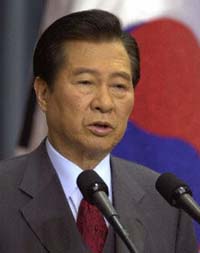
South Korean President Kim Dae-Jung on Thursday urged North Korea to abandon its nuclear weapons and missiles programs and rejoin the world community if it wants to save its crumbling economy.
“Like China and Vietnam, even if (North Korea) is able to maintain its political system, without full-fledged reforms it will not be able to maintain its economic system,” Kim told a news conference here.
The news conference followed Kim’s summit with Indonesian President Abdurrahman Wahid who Thursday began a two-day state visit to South Korea, pledging support for Kim’s “Sunshine policy” of engaging rival North Korea.
“The key message of my Sunshine policy is that North Korea must stop engaging in provocations towards the South and discard any ambitions it has regarding nuclear weapons and mssiles,” he said.
“In return, it (North Korea) will be given the help it needs and will be able to come out of its isolation and back into the international community.
“North Korea knows this, everyone knows this,” Kim said.
“Engagement is the only viable policy. Its a win-win situation for it,” he said stressing that full reform was critical to the survival of the world’s last Stalinist state.
A top US intelligence official told Congress on Wednesday that Pyongyang was continuing to develop missiles, despite a US decision to ease its embargo against the communist country in exchange for a freeze on missile development.
“The program is still alive,” said the Central Intellgence Agency’s Robert Walpole. “The much more capable Taepo Dong-2 (missile) could be flight tested this year, unless North Korea maintains a freeze on flight testing.”
He added that the United States would over the next 15 years face the threat of intercontinental ballistic missiles from Russia, China and North Korea, “probably from Iran and possibly from Iraq.”
North Korea test-launched a medium-range Taepodong I missile over Japan in August 1998 and claimed it was a rocket aimed at putting a satellite into orbit, a move that alarmed Washington and its allies.
Under a September accord with Washington, Pyongyang agreed to a moratorium on test launches in return for an easing of sanctions.
President Kim doubted the Korean peninsula — divided between communism and capitalism in 1945 — would be reunited during his term in office, but was confident that the sometimes explosive Cold War tensions will be eased.
“I want to emphasize that during the remaining three years of my term, I do not think that reunification will take place and this is not my goal now, my goal is to end the Cold War and bring about peaceful exchanges.
“I do believe that if we stay with the (Sunshine) policy with consistency … we will be able to end the Cold War on the Korean peninsula during my term.”
The two Koreas remain technically at war after fighting in the 1950-53 Korean War ended in an armistice that has never been translated into a full peace treaty.
Copyright 1999 AFP. All rights reserved. The material on this page is provided by AFP and may not be published, broadcast, rewritten or redistributed.
