
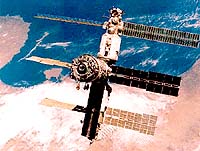
The Russian Aerospace Agency this week signed agreements with Megaruss, Avikos and the Industrial Insurance Company to insure responsibility to injured third parties for possible damages related to the dumping of space station Mir in the South Pacific for $200 million.
Spokesman for the head of the Russian Aerospace Agency Sergei Gorbunov told Interfax on Sunday that the insurance premium is between 0.3% and 0.7% of the insured amount.
The Financial Times reported earlier that a group of London-based companies will reinsure risks related to Mir’s descent. Among them it named a division of France’s AGF and several syndicates of Britain’s Lloyd’s of London.
The tentative date for the deorbiting remains March 20. Experts estimate that when the 137-tonne station enters the dense layers of the atmosphere it will start to break apart. Most of the fragments should melt down and burn up.
The pieces of Mir that do not incinerate–of which there could be up to 1,500–are expected to weigh some 20-25 tonnes and should splash down in the southern part of the Pacific between Australia and South America over an area 6,000 kilometers long and 200 kilometers wide.
Previously on Saturday, mission control told Interfax that Mir would be dumped in the Pacific Ocean in about ten days.
The space station is now orbiting at approximately 250 km above the Earth, a near critical value, an official in the Mission Control Center in Korolyov, Moscow region, told Interfax.
All spaceborne control systems are in order, the official said. When Mir’s altitude falls to 250 kilometers, the conditions of the station’s systems, along the atmospheric variables and Mission Control’s preparedness to handle a 137-tonne station must be tested.
That altitude is expected to decrease by 1,800 to 2,000 meters a day. It is now expected that the station, which weighs 137 tonnes, will drop to 220 km by March 19, if nothing unexpected happens. Mission control will then put Mir into the proper orientation, and 24 hours later signal Mir to excute the braking thrusts necessary to deorbit the station.
The first two impulses will be used for building the trajectory of Mir’s plunge back to Earth. During the next two circuits, Mission Control will check the orbital parameters and then send the final braking impulse to dump the station into the Pacific. After this, the very last leg of the station’s journey will take 45 minutes, mission control specialists say.
According to predictions, the probability that the station will be deorbited successfully is 97-98%. Specialists believe that the probability that those pieces of the station that do not burn up in the atmosphere will hit land is practically “zero percent.”
 Copyright 2001 Interfax. All rights reserved. The material on this page is provided by Interfax and may not be published, broadcast, rewritten or redistributed.
