
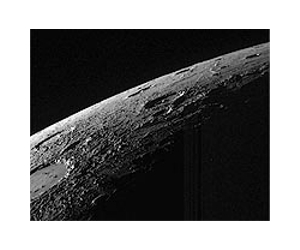
By using solar sailing – rotating the spacecraft and tilting its solar panels to use the very small pressure from sunlight to alter the spacecraft’s trajectory – Messenger navigators have achieved a new record for the smallest miss distance between the intended and actual closest approach distance during a flyby of a planet other than Earth.
On October 6, 2008, the probe flew 199.4 kilometers (123.9 miles) above the surface of the planet. “Our goal was to fly 200 kilometers from the planet’s surface, and we missed that target by only 0.6 kilometers,” explained Messenger Mission Design Lead Jim McAdams, of the Johns Hopkins University Applied Physics Laboratory in Laurel, Md.
That’s pretty remarkable targeting, given that Messenger has travelled 668 million kilometers since its last deep space maneuver in March, McAdams says. “It’s as if we shot an arrow from New York to a target in Los Angeles – nudged it three times mid-stream with a soft breath – and arrived within the width of the arrow’s shaft at the target.”
New Mercury Images Available
The Messenger Science Team has released five new images from the probe’s second flyby of Mercury. When the spacecraft flew by Mercury in January, one of the more dramatic images captured was of the Vivaldi crater at sunset. Two days ago, Messenger’s cameras took this image of Vivaldi <> at sunrise.
This striking view
The MDIS Wide Angle Camera snapped this image
This image
