
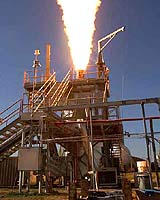
A 28-second test firing April 6 of a scaled-down version of the Space Shuttle’s Reusable Solid Rocket Motor was a success, engineers report. Results from the test ¿ conducted at the Marshall Center ¿ will be used to evaluate the performance of a new internal insulation material that will be used in the aft, or bottom, dome of the motor.
The stationary firing of a scaled-down version of the Space Shuttle’s Reusable Solid Rocket Motor was conducted Tuesday, April 6, at 4:45 p.m. CDT at NASA’s Marshall Space Flight Center in Huntsville , Ala. The 28-second test firing of the modified NASA motor could be heard in the Huntsville area surrounding the Marshall Center.
Static firings of modified NASA motors are part of the ongoing verification of components, materials and manufacturing processes required by the Shuttle’s Solid Rocket Motor Project Office and the Space Shuttle program.
The test, which produces near flight motor internal environments, will be used to evaluate the performance of a new internal insulation material that will be used in the aft, or bottom, dome of the motor.
It will also allow engineers to assess potential instrumentation including one that offers a sharper chemical “map” of the motor’s plume during launch and another that provides more information on the temperature of the nozzle’s phenolics — resin-impregnated fiber reinforced material cured under heat and pressure.
The test motor is deemed one-sixth scale, based on its 9-inch nozzle throat diameter versus the full scale motor’s 54-inch diameter nozzle throat. The duration of Tuesday’s test will be approximately one-fourth the amount of time that motors perform during Shuttle flights.
Engineers from the Marshall Center Space Transportation Directorate and the Shuttle Reusable Solid Rocket Motor project office conducted the test. ATK Thiokol Propulsion Division in Promontory, Utah , manufactures the Shuttle’s Solid Rocket Motor.
“Testing is a key element in our program, providing valuable information on design, process and material changes” said Jody Singer, Manager of the Reusable Solid Rocket Motor Project Office.
Following the test, the data will be analyzed and the results for each objective will be used to better understand the motor’s performance.
