
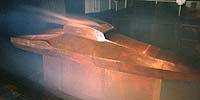
What’s it like to launch a Mach 7 X-plane in a high-risk, high-payback test flight, when everything must go exactly as planned or failure will result?
Three members of the NASA brain trust that made history with the X-43 this March are on hand at the NASA exhibit at EAA AirVenture 2004 in Oshkosh, Wis., this week to answer that and other questions from visitors.
Laurie Marshall and Brad Neal from NASA Dryden Flight Research Center, where the mission launched, and Chuck McClinton from NASA Langley Research Center, where the program is managed, are making a special presentation the evening of July 28 at AirVenture, describing the amazing feat that culminated in the first flight of a scramjet-powered vehicle.
A scramjet uses the last remaining vestiges of oxygen in the atmosphere at high altitudes to promote combustion with hydrogen fuel, unlike a traditional rocket that must carry oxygen on board.
Marshall, Neal, and McClinton join a crew of NASA men and women from around the U.S. who have come to Oshkosh to talk about the many fascinating projects of the Agency. EAA AirVenture, a huge gathering of thousands of airplanes and as many as 800,000 visitors, is an ideal venue to share the NASA story with the public.
The focused Vision for Space Exploration that NASA is pursuing includes elements of the Agency’s aeronautics team. There’s even talk of flying remotely piloted aircraft on Mars, and blimps and balloons in the harsh atmospheres of other planets.
NASA education specialists at AirVenture are available to talk with teachers and parents about the many ways NASA can participate in education programs.
EAA AirVenture Oshkosh 2004 runs through August 2.
