
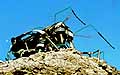
How small can you make a satellite? About half an ounce is the startling answer from a team of Los Alamos National Laboratory researchers who are designing cheap microsatellites with control systems based on the simplest “twitches” of animal neurons.
These insect-like space vehicles could open up important new space
missions, said Kurt Moore and co-authors Janette Frigo and Mark Tilden
in a paper presented today at the American Geophysical Union’s semi-
annual meeting. The paper was part of a session entitled “Science
Closure and Enabling Technologies for Magnetospheric Constellation
Missions.”
The Los Alamos control systems are designed first and foremost to
survive, then to do useful work.
“Instead of designing systems that withstand their environment, we are
engineering systems that rely on their environment,” Moore said.
Among potential missions are measuring solar wind or capturing more
precise images of Earth’s features.
From the earliest days of space exploration, engineers made vehicles
whose primary function was to anticipate and overcome the harsh
environment of space. The Los Alamos team has built tiny robotic
controllers that survive in almost any environment.
Nearly half of costly, complex satellites have failed recently due to loss
of their links with Earth control stations, often a result of space radiation wiping out delicate on-board microprocessors. Satellites increase in vulnerability as they increase in rigidity and complexity of design, Moore said.
“We’re working on satellites that have no microprocessors or fixed
algorithmic behaviors,” Moore said. “Instead, these satellites are
survivors — designed from the bottom up and domesticated by their
sensors and control payloads into performing high-reliability tasks.”
These robust microsatellites represent the logical end of one evolutionary
trend in space exploration — toward clusters of small, cheap satellites
that can achieve results even when some of them fail, Moore said.
Microsatellites are so robust that they even could be used to investigate
the Van Allen radiation belts, which most Earth-orbiting satellites avoid.
The control systems are based on simple “nervous nets,” an instinct-like
neural net in which a single electronic neuron is sufficient to produce a
control pulse, or twitch, in a robotic creature lacking an advanced
processor or computer commands.
Tilden, a robotics engineer, found that with just two neurons he could
create a walking, insect-like robot with remarkable survival skills. With
larger arrays of a few neurons, Tilden made larger, more sophisticated
walkers controlled by central pattern generators that were directly
coupled to the environment.
Nervous nets work like the neurons in animal nervous systems, which put
out spiked pulses that hold useful information in the timing between the
pulses. In computer terms, the information needed to do work lives in the
firing rate, not in a coded voltage level.
The more than 200 types of legged robots Tilden built with these central
pattern generators — which work like the simple independent control loop
that sends messages from one insect leg to the next to keep the creature
moving — have proven reliable, nearly impervious to electrical and
mechanical fault and surprisingly capable of self assembly and collective
behavior.
The Los Alamos model demonstrated at AGU is a microsatellite controller
whose primary mission is to orient itself in Earth’s magnetic field. Using
only a few transistors, these spacebots seek the brightest available
light source, the sun, and set themselves precisely toward it.
Acting like a delay line, electronic pulses from photodetectors travel
first to one neuron, then the next. By adjusting the timing relationship
between the pulses, the control system seeks the light and uses the
reaction of the controller’s magnetic field against Earth’s magnetic field
for the torque needed to orient the satellite.
With six neurons on three axes, the controller can move or examine
different points in three-dimensional space.
Hundreds of microsatellites could relay simple streams of data to a
communications microsatellite, which could integrate the data and pass
it on to a ground station.
Measuring Earth’s magnetosphere is one potential mission. By locating
a swarm of microsatellites on the sunward side of the magnetopause,
scientists could take real-time measurements of the energy transferred to
Earth’s magnetic field by the turbulent solar wind.
“We’ve never really been able to do real-time monitoring of the position
of the magnetopause as the solar wind pushes it around,” Moore
explained. “With hundreds of these microsatellites, we should be able to
do that.”
Another experiment might place on each microsatellite a single imager
sufficient to gather just one high-resolution piece of an image. By
collecting all the pieces, researchers on the ground could obtain highly
accurate pictures of Earth features.
A half-ounce microsatellite, about three inches in diameter, would be
small enough to orient itself within a single fluctuation in space plasma,
Moore said.
“These microsatellites can go where expensive, big satellites can’t go
and they can perform a class of business and science missions that no
other platform can do,” Moore said.
“Nobody knows how little you can go,” he said. “That’s what we aim to find
out.”
