
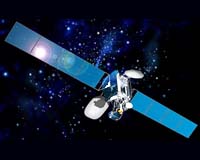
Intelsat 907, the latest in a long line of advanced communications satellites built for Intelsat by Space Systems/Loral, a subsidiary of Loral Space & Communications, was successfully launched at 2:00 a.m. EST Feb 15. The satellite was sent into space from the European Spaceport at Kourou, French Guiana, aboard an Ariane 44L launch vehicle.
Intelsat 907 is the seventh satellite in the Intelsat IX series that SS/L has delivered since 2001. Overall, it is the thirty-first satellite SS/L has delivered to the international communications provider since 1980. SS/L has now built nearly half of Intelsat’s historical space fleet, significantly more than any other manufacturer.
“Space Systems/Loral is proud to be such a substantial supplier to Intelsat,” C. Patrick DeWitt, SS/L’s president and chief operating officer, said. “Our close, two-decade long relationship has played a large part in the success of Space Systems/Loral.”
From its orbital position at 332.5 degrees East longitude, Intelsat 907 will serve the Atlantic Ocean region, including the Americas, Europe and Africa.
The Intelsat IX satellites are some of the largest and most advanced built by SS/L to date. Intelsat 907 carries 22 Ku-band and up to 76 C-band transponders (in 36 MHz equivalents), and has solar arrays that generate more than 9.5 kilowatts of power (beginning of life).
Each Intelsat IX spacecraft carries more high-power amplifiers and generates more solar array power than its predecessors with only a small increase in dry mass.
This increased power and efficiency provide Intelsat with better coverage and stronger signals to help satisfy the demand for digital services, smaller earth stations, and specialized communications services. The Intelsat IX series of satellites are replacing the Intelsat series now on orbit to provide enhanced voice, video, and data transmission services across the globe.
The spacecraft is based on SS/L’s space-proven 1300 geostationary satellite platform, which has an excellent record of reliable operation.
The 1300 is designed to achieve a long useful life, in this case 13 years, excellent station-keeping, and orbital stability by using bipropellant propulsion and momentum-bias systems.
High efficiency solar arrays and batteries provides uninterrupted electrical power. In all, SS/L satellites have amassed nearly 1,000 years of on-orbit service.
