
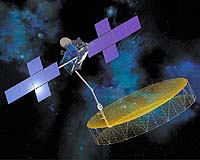
Space Systems/Loral announced Monday that it has completed design reviews of TerreStar Networks’s geostationary satellite, TerreStar-1, and entered into the construction phase of the Mobile Satellite Services (MSS) program.
The TerreStar satellite, together with an Ancillary Terrestrial Component (ATC), will provide next- generation, 2-GHz mobile voice and data communications, monitoring and messaging services throughout the United States.
Scheduled for delivery in 2007, TerreStar-1 has a service life of 15 years and will carry a state-of-the-art MSS payload featuring a large unfurlable reflector.
The satellite will be capable of generating hundreds of spot beams covering the Continental U.S., Canada, Alaska, Hawaii, Puerto Rico and the US Virgin Islands.
SS/L’s contract with TerreStar also includes an option for construction of a second satellite, TerreStar-2.
An FCC decision earlier this year opened the door for TerreStar Networks, and other select satellite operators, to incorporate an ATC with its satellite-delivered communications service.
The previously unavailable 2-GHz frequency band will allow MSS operators to provide advanced mobile voice and data services.
These services will be enhanced by ATC technology, which allows for coverage in areas where a satellite’s signal could be blocked, including urban canyons, dense forest or other areas out of the satellite’s line-of- sight.
“SS/L has taken a leadership position in the development of 2-GHz MSS satellites, which are at the heart of next generation mobile services,” said
C. Patrick DeWitt, president, Space Systems/Loral. “Together with our experience on other 2-GHz systems, the TerreStar award positions SS/L as the industry leader in the design and development of some of the world’s most advanced mobile communication systems.”
TerreStar-1 is based on SS/L’s space-proven 1300 platform, which has an excellent record of reliable operation.
Its high efficiency solar arrays and lightweight batteries are designed to provide uninterrupted electrical power. In all, SS/L satellites have amassed more than 1,100 years of reliable on- orbit service.
