

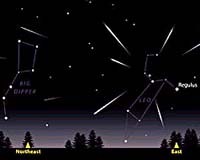
After putting on spectacular performances for the last four years running, the Leonid meteor shower is due to sweep across Earth one more time during the early-morning hours of Tuesday, November 19th, Sky & Telescope magazine reports. If the weather is clear, we could be in for a grand celestial show.
Every year since 1998 the world has witnessed an impressive meteor shower around this date, when Earth passes through a narrow stream of rubble in space left by Comet Tempel-Tuttle. Meteor showers have long been hard to predict accurately, but astronomers’ experience with the Leonids in the last several years has finally given them a good handle on the subject. In 2001 meteor astronomers got it just right. Countless thousands of skywatchers alerted by Sky & Telescope and other news media went out before dawn at the predicted date and time and witnessed the richest meteor display over North America in 35 years.
This year meteor forecasters predict that we will again get a strong shower, or “meteor storm,” at certain times on the morning of November 19th. They also say this will probably be the last strong Leonid shower that Earth will encounter for a century.
Unfortunately, bright moonlight this year will fill the sky and compromise the view. Faint meteors will be mostly hidden in the moonlight, though bright ones should show through just fine.
According to the November 2002 issue of Sky & Telescope, this year’s shower is likely to come in two waves, each lasting a couple of hours, that will peak around 4:00 and 10:40 Universal Time (UT, also called Greenwich mean time, GMT) on the 19th. What that means to you depends on where on the globe you are located.
The first peak is well timed for skywatchers in Europe, North and West Africa, and northeasternmost North America. The second peak favors all of North America, but especially the central and western parts of the continent.
When is the best time to watch? That depends on your time zone. Here’s a rundown:
EASTERN TIME ZONE: If you’re in the U.S. Northeast or the Canadian Maritimes, you can start watching the sky as early as 11:30 p.m. EST on Monday night the 18th. The first peak will already be passing, but not until about this time will the shower’s apparent point of origin (its “radiant” in the constellation Leo) rise above your horizon, allowing any meteors at all to reach your part of the world. Watch for a few very long, spectacular streamers passing overhead — meteors skimming the top of the atmosphere above you almost horizontally. They’ll be flying roughly east to west. Keep watching until at least 1 a.m.
The second peak should pick up steam before and during dawn Tuesday morning. These meteors will be shorter and perhaps more numerous. Start looking two hours or more before sunrise (in other words, approximately 4:30 a.m. EST; look up your local sunrise time in the newspaper or use the almanac on Sky & Telescope’s Web site and work backward from there). The nominal peak should come around 5:40 a.m. EST. Depending on where you live, the meteors may keep increasing in numbers right up until they fade from sight in the growing light of day.
CENTRAL TIME ZONE: On Tuesday morning, watch from about 3:30 a.m. CST onward. The shower is predicted to peak around 4:40 a.m. and will probably be tapering off by the beginning of dawn. (The first peak, described for the eastern time zone, is out of sight from here and points west.)
MOUNTAIN TIME ZONE: On Tuesday morning, watch from about 2:30 a.m. onward.
The meteor shower is likely to peak around 3:40 a.m. MST.
PACIFIC TIME ZONE: On Tuesday morning, watch from about 1:30 a.m. onward.
The shower is likely to peak around 2:40 a.m. PST. What direction should you look? “Up!” says Sky & Telescope senior editor Alan MacRobert. “The meteors will appear all over the sky, so just watch whatever part of your sky is darkest. Keep the Moon out of your view so it doesn’t dazzle your eyes.”
