

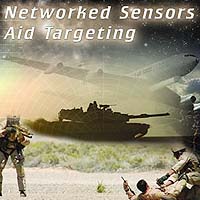
L-3 Communications has announced that its ComCept (L-3 ComCept) division will showcase its Network Centric Collaborative Targeting (NCCT) program at the U.S. Navy’s Trident Warrior exercise from November 28 to December 9, 2005.
Utilizing the largest constellation of networked Intelligence Surveillance and Reconnaissance (ISR) systems ever brought together for demonstration, NCCT will network space, aircraft, ships and ground ISR sensor platforms, as well as command and control systems from the U.S. Air Force (USAF), U.S. Navy, U.S. Army and United Kingdom during the NCCT program’s Joint Military Utility Assessment along the Virginia and Carolina coastline.
Conducted by the U.S. Navy’s Network Warfare Command in Norfolk, VA, the Trident Warrior series of experiments are designed to test and evaluate network centric systems that could be fielded in the near term. Over 60 experimental systems are participating in this year’s event.
L-3 ComCept is the developer and prime contractor for NCCT. As prime, L-3 ComCept subcontracts and works with multiple platform and system prime contractors and the U.S. Government to form a successful team.
The team, including L-3’s ComCept, Integrated Systems, ILEX and Communication Systems- West businesses, earned the distinction of being selected as the Advanced Concept Technology Demonstration (ACTD) team of the year in 2004 and has been the driving force behind creating a successful network.
“Today’s military warfare environment is dynamic, fast paced and unpredictable. Warfighters require up to the minute situational awareness and intelligence information made available to all levels, from the commander down to the individual soldier. Just as teamwork exponentially improves the capabilities of individuals in a group, NCCT’s sensor networking dramatically improves detection, identification, tracking and engagement capabilities by fusing multiple intelligence sources.” said Gary Davis, program director at L-3 ComCept.
NCCT forms a networked constellation of disparate platforms by applying common software applications on all sensor platforms, creating a machine-to-machine network that allows currently incompatible multi-intelligence sources to form a collaborative team. This creates a virtual platform that provides actionable information on fixed, stationary and moving surface targets.
Operationally, NCCT improves the responsiveness and utility of ISR operations to enable real-time targeting and mission planning. By exploiting multi-sensor attributes collaboratively, time and geolocation accuracies enable precision engagement and electronic attack to be directed precisely and effectively.
The USAF successfully completed its Military Utility Assessment of the NCCT last year at Joint Expeditionary Force Experiment 2004 (JEFX-04) and transitioned the ACTD to a funded program of record. This year’s evaluation will complete the desired joint and coalition assessment prior to the system’s initial fielding on USAF C(2)ISR platforms, leading to a 2009 initial operational capability (IOC).
Additionally, the U.S. Navy has indicated an interest in using NCCT for multiple airborne and ship platforms and the UK is also assessing the performance of NCCT during the Trident Warrior exercises for applications on its LISTENER Program.
