
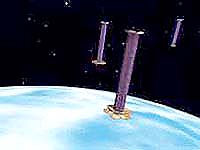
Air Force Research Laboratory’s Space Vehicles Directorate has awarded $35 million to ITN Energy Systems Inc., in Denver, CO, to build three TechSat 21 satellites. The microsatellites will demonstrate formation flying and sparse aperture sensing.
“The availability of such low cost, highly capable microsatellites will lead to new ways of doing business in space and this ‘personal satellite’ paradigm can revolutionize the space industry in much the same way as the personal computer has done to the computer industry,” said Dr. Alok Das, chief technologist for the Space Vehicles Directorate.
The three TechSat 21 satellites will be built at approximately 120 kilograms each and will operate as a “virtual satellite” with X-band transmit and receive payloads on each to form a large, sparse aperture system. Technologies include compact PCI avionics, precise differential GPS positioning, intersatellite ranging and communication, advanced phased array antennas, micro-propulsion, multi-functional structures, thin-film photovoltaics, and lithium-ion batteries.
The Air Force, NASA and other government space agencies are making significant advances in reducing the size, weight, and cost of satellite subsystems. The Air Force Office of Scientific Research has also sponsored ground-breaking research in such areas as formation flying, sparse aperture signal processing, micro-propulsion, and distributed satellite operations.
Next generation microsatellites promise to be 10 times lighter and as much as 10 times cheaper than current systems with capabilities approaching those of 1000 kilograms class satellites of today.
These highly capable, lightweight microsatellites enable such new mission concepts as on-orbit satellite inspection and servicing, multiple-satellite formations, and aircraft missile launches of microsatellites for rapid response tactical missions.
Additional team members subcontracted under this effort include Global Solar Energy, Ball Aerospace and Technologies Corporation, Lockheed Martin Corporation, Broad Reach Engineering, AeroAstro Inc., Creare Inc., L’Grade Inc., AEC-Able Engineering, and Yardney Technical Products.
Air Force Research Laboratory provides the Air Force the technological edge to control the air, space and information through scientific and technological discoveries and development. Working together with industry keeps our Air Force the best in the world.
