
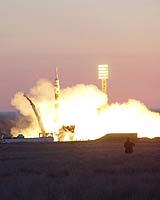
A Russian Soyuz TMA8 rocket lifted off at 8:30 a.m. local time, burning its four liquid-fueled boosters plus its core engine and carrying three crew members on the 13th mission to the International Space Station.
The rocket carried the three-member crew of Russian commander Pavel Vinogradov and American flight engineer Jeff Williams – who have logged a combined 208 days in space – and Marcos Pontes from Brazil – the first space station crew member who has not been an American or a Russian.
The launch went entirely according to plan, with the rocket reaching orbital speed at 10 minutes and 20 seconds after launch, and lifting the spacecraft into an elliptical orbit of 118 miles by 143 miles (191 kilometers by 232 kilometers). The Soyuz will continue to adjust its orbit for the next two days, and is scheduled to rendezvous with the station at 10:19 p.m. Central Time on Friday.
The inclusion of Pontes also marks the beginning of a new leapfrogging strategy developed by the station partners to deliver crewmembers. Pontes will remain aboard the orbiting facility only until April 8, when he will return to Kazakhstan with the Expedition 12 crew of Bill McArthur, the commander, and Valery Tokarev, the flight engineer. Future missions will include crew members from Canada, Japan and ESA.
“We just could not be more pleased with the cooperation from our partners,” said Rex Geveden, NASA’s associate administrator, who was visiting Baikonur to witness the launch.
“We are more than just co-workers,” said Vinogradov, “we are friends. We are ready. We are looking at completing some very serious tests.”
Vinogradov and Williams are scheduled to remain aboard the station until September.
