

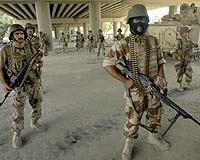
Iraq’s “public order” police forces have fewer than 10 percent of the non-commissioned officers they need and an aggressive recruitment campaign is underway to find them, a senior U.S official said Friday. Col. Skip Davis, the commander of the Special Police Transition Team, National Police Order Division, also said he is confident none of the public order police his troops are training have been involved in ethnically or politically motivated attacks on other Iraqis.
“We feel very secure within the Public Order Division (and I’m sure) the special police commandos would say the same thing about the fact that we don’t have vigilantes running about without our supervision or without our knowing it,” Davis told Pentagon reporters. “We’ve got a team with every single battalion. There are no separate company bases that would be perhaps underneath or outside of our oversight or supervision. We do — we accompany them on all their missions. We also see where those detainees go because we help in the processing and medical screening of every detainee that comes in.
“It’s nearly impossible to hide that from the Special Police Transition Teams, so I don’t think that that exists within the national police we work with, and we certainly haven’t seen any of it in SPTT,” he said.
Iraq’s Interior Ministry has opened an investigation into an alleged plot by four highway patrolmen to kidnap and kill a Sunni man. A group of 22 highway police were stopped by U.S. forces at a traffic checkpoint this week, and four were taken into U.S. custody.
A top U.S. official Thursday acknowledged the presence of militias in the Iraqi security forces, some of which have “displaced loyalties.”
“There are indeed militias, and the Iraqi law wants to integrate those militias into the Iraqi security force or disband those militias,” said Maj. Gen. Rick Lynch, a spokesman for the U.S. led military coalition in Iraq. “Some of them did that, some of them still have displaced loyalties that have joined the Iraqi security forces … and they could conduct the same kind of thing that we saw in that particular event.”
The Interior Ministry has still not completed an investigation into an apparently secret MOI jail in Baghdad discovered by U.S. forces last year. Dozens of prisoners — mostly Sunni — were malnourished and several showed signs of abuse or torture.
Sunni Arabs comprise about 25 percent of Iraq’s population, but held most of the political power in the country for the last century, and especially so under Saddam Hussein for nearly 30 years. Shiite Muslims and Kurds were often attacked and persecuted by Saddam’s largely Sunni forces, and some of the violence in Iraq is now being attributed to Shiite retribution.
According to Davis, just under 80 percent of the 9,000-strong public order police force are Shiites and a little more than 20 percent are Sunni, along with a small number of Kurds and other groups. He is looking to recruit another 1,600 public order police, primarily among Sunnis, to bring the force more in line with the demographics of the country, he said.
At the same time, he and the 17, 11-man teams of soldiers and Marines training the public order battalions are focusing on a rapid expansion of the non-commissioned officer corps.
NCOs are senior enlisted personnel with leadership responsibility and authority over day-to-day operations. In general, officers plan and direct operations, and NCOs see that they are carried out on the battlefield.
There are 9,000 public order police — police with counterinsurgent and paramilitary training, used to reinforce local police. Of those, just 157 are NCOs, but there are some 2,000 positions authorized. Within a few weeks another 150 NCOs will begin training.
The problem with NCOs is one seen by American military across the entire Iraqi security forces. Saddam Hussein’s army — for reasons of fear, paranoia, and ego — did not empower low-level soldiers with authority or training. They were merely meant to take orders, according to U.S. military officials with close ties to training. It is one reason why they believe Iraq’s force folded so quickly under the American invasion: Once communications lines were cut off, low-level soldiers did not know what to do and were not inclined or trained to take the initiative.
“Almost like any Iraqi security force, we’ve had difficulty in professionalizing the force over time just based on the fact that they’re coming out of their basis of experience (in the) pre-Saddam Iraqi army, with those biases that those forces had … as well as a lack of professional and a strong NCO core, and that’s really where our major problem is in terms of unit control or individual discipline,” Davis said.
Source: United Press International
