
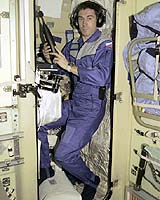
There’s a new crewmember aboard the International Space Station who is never at a loss for words. Clarissa is the International Space Station’s new speech-powered virtual assistant.
This software eventually may help astronauts check out space suits and analyze drinking water quality – all via voice. In the future, Clarissa has the potential to talk astronauts through thousands of important procedures related to life support systems, medical exams, and equipment checkout.
The experimental Clarissa application was created using speech recognition software from Nuance, the voice automation expert. Clarissa is set to begin working with astronauts during the next six months as part of International Space Station Expedition 11.
“Nuance is thrilled to be an integral part of the NASA-Clarissa project, taking voice automation to new heights – literally,” said Chuck Berger, President and CEO, Nuance.
“While voice automation has become a mainstream business imperative for everything from telecommunications providers to banks, Clarissa illustrates the important role speech will play in our daily lives in the very-near future.”
Pre-Clarissa, astronauts – when trying to analyze water samples – scrolled through multiple pages of instructions, following each step of the procedure. Considering that computers and crewmembers float in microgravity, securing laptops to the International Space Station’s walls and trying to type has proved to be more than challenging.
During a recent validation test on the ground, speech-powered Clarissa, which recognizes words and sentences, led astronaut Ellen Baker through several water quality analysis procedures, listening for “next,” “complete” and “repeat” commands before reading the appropriate directive.
NASA hopes to test Clarissa aboard the International Space Station sometime between late April and October 2005.
At Clarissa’s core is a state of the art dialogue manager and Nuance’s latest market-leading speech recognition software. It’s the most accurate, scalable, and easy-to-deploy voice automation software on the market.
The Clarissa system was developed by scientists at the NASA Ames Research Center, Moffett Field, Calif., and installed on the International Space Station on January 13, 2005.
In ground tests conducted thus far, Clarissa showed how it could boost crewmember efficiency by allowing astronauts to better focus on the task at hand without having to navigate a PDF guide with a keyboard and mouse.
